


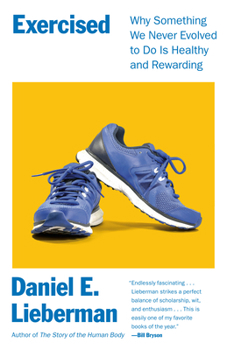
Exercised: Why Something We Never Evolved to Do Is Healthy and Rewarding


Select Format
Select Condition 
Book Overview
If exercise is healthy (so good for you!), why do many people dislike or avoid it? These engaging stories and explanations will revolutionize the way you think about exercising--not to mention sitting, sleeping, sprinting, weight lifting, playing, fighting, walking, jogging, and even dancing.
"Strikes a perfect balance of scholarship, wit, and enthusiasm." --Bill Bryson, New York Times best-selling author of The Body - If we are born to walk and run, why do most of us take it easy whenever possible?
- Does running ruin your knees?
- Should we do weights, cardio, or high-intensity training?
- Is sitting really the new smoking?
- Can you lose weight by walking?
- And how do we make sense of the conflicting, anxiety-inducing information about rest, physical activity, and exercise with which we are bombarded? In this myth-busting book, Daniel Lieberman, professor of human evolutionary biology at Harvard University and a pioneering researcher on the evolution of human physical activity, tells the story of how we never evolved to exercise--to do voluntary physical activity for the sake of health. Using his own research and experiences throughout the world, Lieberman recounts without jargon how and why humans evolved to walk, run, dig, and do other necessary and rewarding physical activities while avoiding needless exertion. Exercised is entertaining and enlightening but also constructive. As our increasingly sedentary lifestyles have contributed to skyrocketing rates of obesity and diseases such as diabetes, Lieberman audaciously argues that to become more active we need to do more than medicalize and commodify exercise. Drawing on insights from evolutionary biology and anthropology, Lieberman suggests how we can make exercise more enjoyable, rather than shaming and blaming people for avoiding it. He also tackles the question of whether you can exercise too much, even as he explains why exercise can reduce our vulnerability to the diseases mostly likely to make us sick and kill us.
"Strikes a perfect balance of scholarship, wit, and enthusiasm." --Bill Bryson, New York Times best-selling author of The Body - If we are born to walk and run, why do most of us take it easy whenever possible?
- Does running ruin your knees?
- Should we do weights, cardio, or high-intensity training?
- Is sitting really the new smoking?
- Can you lose weight by walking?
- And how do we make sense of the conflicting, anxiety-inducing information about rest, physical activity, and exercise with which we are bombarded? In this myth-busting book, Daniel Lieberman, professor of human evolutionary biology at Harvard University and a pioneering researcher on the evolution of human physical activity, tells the story of how we never evolved to exercise--to do voluntary physical activity for the sake of health. Using his own research and experiences throughout the world, Lieberman recounts without jargon how and why humans evolved to walk, run, dig, and do other necessary and rewarding physical activities while avoiding needless exertion. Exercised is entertaining and enlightening but also constructive. As our increasingly sedentary lifestyles have contributed to skyrocketing rates of obesity and diseases such as diabetes, Lieberman audaciously argues that to become more active we need to do more than medicalize and commodify exercise. Drawing on insights from evolutionary biology and anthropology, Lieberman suggests how we can make exercise more enjoyable, rather than shaming and blaming people for avoiding it. He also tackles the question of whether you can exercise too much, even as he explains why exercise can reduce our vulnerability to the diseases mostly likely to make us sick and kill us.
Format:Paperback
Language:English
ISBN:052543478X
ISBN13:9780525434788
Release Date:December 2021
Publisher:Vintage
Length:464 Pages
Weight:1.09 lbs.
Dimensions:0.9" x 5.2" x 7.9"
Customer Reviews
2 ratings
Good for What It Is: A Review of Exercised
Published by Randy Ehrler , 1 month ago
Exercised reads like a Gladwell book, each chapter built around a specific population, region, or activity, using story and anthropology to make its point accessible and engaging. For a general reader curious about the science of movement, it delivers genuinely well.
Lieberman's most compelling insight is also his most sobering: we are designed to move, but historically rest was earned through genuine physical labor. Daily life demanded effort. Now we live in a civilization that relentlessly engineers comfort, and rest arrives unearned. That reframing alone is worth the read.
But his argument stops at the threshold of basic health maintenance, enough movement to avoid getting sick. That is a worthy goal. It is not, however, the whole question.
If you want to understand what it means to truly inhabit a body, to thrive without restriction for as long as possible, Lieberman is a solid starting point, not a destination.
A very thorough study of exercise
Published by LP , 3 months ago
I am a person who has had periods where I should have done more exercise, and periods where I was doing more than many people. I really enjoy exercising; it has helped me find the right mix (running, swimming, weights & hot yoga). I have thought about the amount of exercise our ancestors did in the past, and the book discussed this topic.
Copyright © 2026 Thriftbooks.com
Terms of Use | Privacy Policy | Do Not Sell/Share My Personal Information | Cookie Policy | Cookie Preferences | Accessibility Statement
ThriftBooks ® and the ThriftBooks ® logo are registered trademarks of Thrift Books Global, LLC
ThriftBooks ® and the ThriftBooks ® logo are registered trademarks of Thrift Books Global, LLC
