


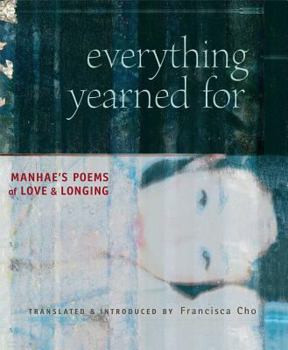
Everything Yearned for: Manhae's Poems of Love and Longing

Select Format
Select Condition 
Book Overview
Manhae (1879-1944), or Han Yongun, was a Korean Buddhist (Son) monk during the era of Japanese colonial occupation (1910-1945). Manhae is a political and cultural hero in Korea, and his works are studied by college students and school children alike. Everything Yearned For is a collection of 88 love poems, evocative of the mystical love poetry of Rumi, and even reminiscent of the work of Pablo Neruda.Though Manahe's poetry can be read allegorically on many levels - political and religious - it is completely unlike any other poetry in Buddhist or secular realm. The first poem, "My Lover's Silence," narrates the lover's departure and establishes the enduring themes of the work: the happiness of meeting, the sadness of separation, the agony of longing and waiting, and, most of all, the perfection of love in absence that demands the cost of one's ongoing life, as opposed to the relief of death. The Korean word translated in these poems as "love" and "lover" is nim, though nim has many and broad interpretations. Understandably, the identity of Manhae's lover, or "nim" has been the subject of much speculation. Manhae writes in his own preface: "Nim" is not only a human lover but everything yearned for. All beings are nim for the Buddha, and philosophy is the nim of Kant. The spring rain is nim for the rose, and Italy is the nim of Mazzini. Nim is what I love, but it also loves me. If romantic love is freedom, then so is my nim. But aren't you attached to the lofty name of freedom? Don't you also have a nim? If so, it's only your shadow. I write these poems for the young lambs wandering lost on the road home from the darkening plains.
Format:Hardcover
Language:English
ISBN:086171489X
ISBN13:9780861714896
Release Date:January 2005
Publisher:Wisdom Publications
Length:192 Pages
Weight:0.75 lbs.
Dimensions:0.8" x 6.6" x 7.7"
Customer Reviews
2 ratings
Superb all the way around
Published by Thriftbooks.com User , 19 years ago
A beautiful translation of the poems of Han Yong-un, nom de plume Manhae. The book itself is gorgeous as well, superbly constructed and with a lovely cover illustration. The author does a remarkable job in capturing the essence of meaning, while preserving the aesthetic beauty of the poetry from its original language. Don't purchase this expecting a collection of romantic Shakespeare sonnets; you'll be slightly disappointed by the lack of lines you can recite to your intended. The closest it comes to "shall I compare thee to a summer day" is one poem which does indeed compare the intended to jade and other precious goods, but begins and ends with lines to the effect of "it's not quite right to call you beautiful." Kind of a mood killer if your goal is to impress that special someone. What Manhae does provide is wonderful, utterly sublime lines of longing, the pain of seperation, and often unrequited desire. The title does well in capturing the sensibility of the poems - think of a type of love where the entire world and everything in it conspires to remind you of the object of your desire. The oft ambiguous sex of the narrator actually adds to this ambience, and the tone and content of some poems does lend a degree of believability to rumors that some (if not all) of the poems were written by a Buddhist nun instead of the implied author. One can easily see and interpret some of the works in the context of an author active in the nationalistic Korean independence movement Superb work which will undoubtedly be the definitive translation. Manhae deserves to be brought out of obscurity for western readers and enjoyed, and this translation should do well to accomplish that.
Translations as they should be
Published by Thriftbooks.com User , 19 years ago
When this book was first published in 2005, the poet Robert Pinsky wrote in his Washington Post column: "One of the fathers of the Korean independence movement was Manhae, an important figure not only in poetry but also in religion, culture and politics. An American poet reads with a gasp that Manhae, a monk who profoundly influenced Buddhist thought and practice, was also a coauthor of the Korean Declaration of Independence. As Han Yong-un, he was also a founding modern poet. So here are significant accomplishments comparable to those of Thomas Jefferson, Walt Whitman and Ralph Waldo Emerson, all credited to someone born in 1879, the same year as the American businessman-poet Wallace Stevens. (. . .) In Cho's English renderings, these poems have the power to expand an American reader's notion of poetry." That's quite a strong endorsement! Former American Poet Laureate Robert Hass, reviewing Ko Un's "Ten Thousand Lives" at about the same moment, included a mention of this book too: "Manhae, writing a sort of rhythmic prose in the manner of Tagore, produced something quite new in Korean literature, a book of intensely spiritual love poems. The situation of the lovers is not clear; even the gender of the beloved is not clear, and Manhae wrote a preface to the book which invited allegorical readings. The loved one is not only the beloved; it is also everything yearned for. If all living beings are the beloved for Sakyamuni, philosophy is the beloved for Kant. If the spring rain is the beloved for the rose, then Italy is the beloved for Mazzini. Han Yong-un's career as a poet begins and ends with this one mysterious book, and its intensities have been read by several generations of poets as an allegory of political oppression, and in the postwar years the beloved became a Korea made whole again. Erotic anguish has become political anguish and also a text in Buddhist spirituality. Han Yong-un died in 1944, just before Korea was liberated from the Japanese by the bombs at Hiroshima and Nagasaki. Francisca Cho, in her fresh and intelligent rendering of the book, has retitled it Everything Yearned For: Manhae's Poems of Love and Longing.[4] By translating the Korean word nim, "love" in English, with the phrase from Manhae's preface, "Everything Yearned For," she has sidestepped the somewhat sappy diction of previous translations and suggested that muffled and painful quality of longing with which the poems are suffused." If Pinsky and Hass can write like that about this book, what more can I add?
Copyright © 2026 Thriftbooks.com
Terms of Use | Privacy Policy | Do Not Sell/Share My Personal Information | Cookie Policy | Cookie Preferences | Accessibility Statement
ThriftBooks ® and the ThriftBooks ® logo are registered trademarks of Thrift Books Global, LLC
ThriftBooks ® and the ThriftBooks ® logo are registered trademarks of Thrift Books Global, LLC
