


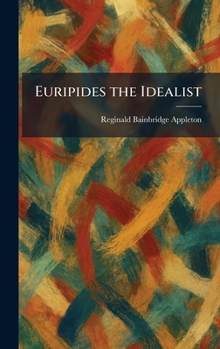
Euripides the Idealist

Select Format
Select Condition 
Book Overview
"Euripides the Idealist" by Reginald Bainbridge Appleton is a profound scholarly exploration of the philosophical and artistic motivations of one of ancient Greece's most enduring playwrights. This work delves into the thematic depth of Euripides' tragedies, challenging the traditional view of him as a mere realist or skeptic. Instead, Appleton argues for a sophisticated underlying idealism that permeates his treatment of myth, human emotion, and social morality.
By examining key plays and surviving fragments, the author illustrates how Euripides used the Athenian stage to grapple with complex ethical dilemmas and the intricacies of the human condition. The book serves as a valuable resource for students and scholars of classical studies, offering deep insights into the evolution of dramatic form and the intellectual landscape of fifth-century Athens. Appleton's analysis highlights the playwright's unique ability to blend critical inquiry with a high poetic vision, making "Euripides the Idealist" a significant contribution to the study of Hellenic literature. This volume remains an essential guide for anyone seeking to understand the enduring relevance of Euripidean thought and its foundational impact on the Western literary tradition.
This work has been selected by scholars as being culturally important, and is part of the knowledge base of civilization as we know it. This work was reproduced from the original artifact, and remains as true to the original work as possible. Therefore, you may see the original copyright references, library stamps (as most of these works have been housed in our most important libraries around the world), and other notations in the work.
This work is in the public domain in the United States of America, and possibly other nations. Within the United States, you may freely copy and distribute this work, as no entity (individual or corporate) has a copyright on the body of the work.
As a reproduction of a historical artifact, this work may contain missing or blurred pages, poor pictures, errant marks, etc. Scholars believe, and we concur, that this work is important enough to be preserved, reproduced, and made generally available to the public. We appreciate your support of the preservation process, and thank you for being an important part of keeping this knowledge alive and relevant.
Customer Reviews
ThriftBooks ® and the ThriftBooks ® logo are registered trademarks of Thrift Books Global, LLC
