


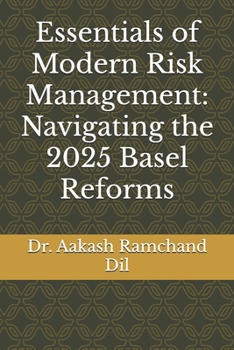
Essentials of Modern Risk Management: Navigating the 2025 Basel Reforms
No Customer Reviews

The evolution of risk management has been a dynamic journey reflecting the complexities of the financial landscape. In the early days, risk management was often rudimentary, primarily focusing on the identification and mitigation of risks through simple compliance measures. However, as financial markets became more sophisticated, so too did the strategies employed to manage risk. This shift has been largely driven by regulatory changes, technological advancements, and an increased understanding of financial interdependencies.
With the advent of the Basel Accords, particularly the recent updates in 2025, risk management has undergone a significant transformation. These reforms have introduced more stringent capital requirements and stress testing frameworks that compel financial institutions to adopt a more proactive and holistic approach to risk assessment. The emphasis on quantitative models for scenario analysis has become critical, enabling banks to simulate various economic conditions and assess potential vulnerabilities.
Fostering a strong risk culture and governance framework is essential for the successful implementation of modern risk management practices. As institutions navigate the complexities introduced by the 2025 Basel reforms and the digital landscape, cultivating an organisational culture that prioritises risk awareness and compliance becomes crucial. This cultural shift, combined with robust operational resilience strategies, will enable banks to withstand economic disruptions and maintain stability in an ever-evolving financial environment.
With the advent of the Basel Accords, particularly the recent updates in 2025, risk management has undergone a significant transformation. These reforms have introduced more stringent capital requirements and stress testing frameworks that compel financial institutions to adopt a more proactive and holistic approach to risk assessment. The emphasis on quantitative models for scenario analysis has become critical, enabling banks to simulate various economic conditions and assess potential vulnerabilities.
Fostering a strong risk culture and governance framework is essential for the successful implementation of modern risk management practices. As institutions navigate the complexities introduced by the 2025 Basel reforms and the digital landscape, cultivating an organisational culture that prioritises risk awareness and compliance becomes crucial. This cultural shift, combined with robust operational resilience strategies, will enable banks to withstand economic disruptions and maintain stability in an ever-evolving financial environment.
Format:Paperback
Language:English
ISBN:B0FMQJMKW8
ISBN13:9798298509930
Release Date:August 2025
Publisher:Independently Published
Length:66 Pages
Weight:0.22 lbs.
Dimensions:0.1" x 6.0" x 9.0"
Customer Reviews
0 rating
Copyright © 2026 Thriftbooks.com
Terms of Use | Privacy Policy | Do Not Sell/Share My Personal Information | Cookie Policy | Cookie Preferences | Accessibility Statement
ThriftBooks ® and the ThriftBooks ® logo are registered trademarks of Thrift Books Global, LLC
ThriftBooks ® and the ThriftBooks ® logo are registered trademarks of Thrift Books Global, LLC
