


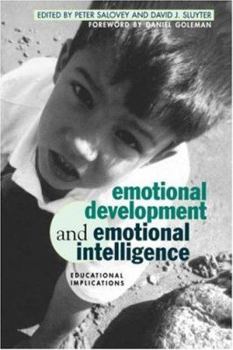
Emotional Development and Emotional Intelligence: Educational Implications

Select Format
Select Condition 
Book Overview
In recent years, innovative schools have developed courses in what has been termed emotional literacy, emotional intelligence, or emotional competence. This volume evaluates these developments scientifically, pairing the perspectives of psychologists with those of educators who offer valuable commentary on the latest research. It is an authoritative study that describes the scientific basis for our knowledge about emotion as it relates specifically to children, the classroom environment, and emotional literacy.Key topics include: historical perspectives on emotional intelligence neurological bases for emotional development the development of social skills and childhood socialization of emotion. Experts in psychology and education have long viewed thinking and feeling as polar opposites reason on the one hand, and passion on the other. And emotion, often labeled as chaotic, haphazard, and immature, has not traditionally been seen as assisting reason.All that changed in 1990, when Peter Salovey and John D. Mayer coined the term emotional intelligence as a challenge to the belief that intelligence is not based on processing emotion-laden information. Salovey and Mayer defined emotional intelligence as the ability to monitor one's own and others' feelings and emotions, to discriminate among them, and to use motivated scientists, educators, parents, and many others to consider the ways in which emotions themselves comprise an intelligent system.With this groundbreaking volume, invited contributors present cutting-edge research on emotions and emotional development in a manner useful to educators, psychologists, and anyone interested in the unfolding of emotions during childhood. In recent years, innovative schools have developed courses in "emotional literacy" that making; these classes teach children how to understand and manage their feelings and how to get along with one another. Many such programs have achieved national prominence, and preliminary scientific evaluations have shown promising results.Until recently, however, there has been little contact between educators developing these types of programs and psychologists studying the neurological underpinnings and development of human emotions. This unique book links theory and practice by juxtaposing scientific explanations of emotion with short commentaries from educators who elaborate on how these advances can be put to use in the classroom.Accessible and enlightening, Emotional Development and Emotional Intelligence provides ample evidence about emotional intelligence as well as sound information on the potential efficacy of educational programs based on this idea.
Format:Hardcover
Language:English
ISBN:0465095879
ISBN13:9780465095872
Release Date:June 1997
Publisher:Basic Books
Length:288 Pages
Weight:1.35 lbs.
Dimensions:1.2" x 6.5" x 9.6"
Customer Reviews
3 ratings
this is just to ask you a question about a review I wrote!
Published by Thriftbooks.com User , 27 years ago
HiI wrote a review a while back.Recently one of guys who wrote a chapter in the book emailed me that made a mistake in who I attributed which chapters to. If I send you a corrected review, will you replace the old one? I think tht would be easier than trying to reword the old one.Thanks Stevehein@hotmail.com
A well-presented collection of valuable research.
Published by Thriftbooks.com User , 27 years ago
Emotional intelligence has become an interesting area of research in the fields of psychology and education. Salovey and Sluyter enlighten readers by providing an understanding of emotional intelligence and how this construct is vital to successful human adaptation. The editors include works by several prominent researchers that offer varying perspectives on the development of human emotions, and many educational implications. A particularly refreshing component of this book is the inclusion of a K-12 educator's commentary at the end of each chapter.Salovey and Sluyter provide a well-presented collection of valuable research on the popular topic of emotional intelligence. This book is recommended for everyone that is interested in the recent research on emotional intelligence and emotional development. However, Emotional Development and Emotional Intelligence is essential for researchers, teachers, and other professionals in the fields of education and psychology. It provides an important link between empirical research and practical applications of emotional intelligence. Although research on emotional intelligence continues, this book is the first step towards founding a knowledge base on this important construct.
Great summary of EI research for educators, bit hard to read
Published by Thriftbooks.com User , 27 years ago
Peter Salovey and his colleague, John Mayer, were apparently the first to use the term "emotional intelligence" in their academic research. Of special interest is Salovey's new definition of the term which he offers in this book (in the first article.)The book is a collection of academic articles which each offer lots of research journal citations. This makes it easy for someone to do further research. (Very handy for college students writing papers!)Salovey only wrote two articles for the book. I would prefer to have seen more of his writing. It seems to be a bit more concise. Some of the contributors get very wordy and overly academic when they could say things much more simply.Each article is followed by a short commentary by an K-12 educator. I found these commentaries are only somewhat helpful. Even they were pretty academic. I would prefer more practical suggestions, such as those on my site (see below) If you have a masters or Ph.D. you won't have too much trouble with the book. But it is not written for the average second grade teacher.Still, it is worth the time it takes to read it, and I would agree that it is an "authoritative" book. Peter Salovey by the way, seems to be more concerned with making a positive difference in the world, while Daniel Goleman seems to be more concerned with making a fortune and a name for himself. Salovey is, for example, is working with educators while Goleman is pandering to the corporations with his new book on EQ for business.And I personally agree with most of Salovey's approach to EI in education. For example, he says teach EI lessons as the opportunity arises throughout the day. He understates the importance of the teacher's emotions and his/her own level of EI, however. Teachers have a lot of work to do on their own emotional management before they will be good instructors and, more importantly, models, of EI.Article 4 by Greenberg and Snell is the best single article I have seen on the child's brain and the importance of healthy emotional nurturing in the first few years. Other especially informative articles were 5 and 6 on regulation of emotions. Article 9 is interesting in how it suggests we apply academic research to practical educational settings.SummaryA bit pricey, but full of research data and references as well as very interesting information on the brain and the child's emotional development. And as the title suggests, it does address educational implications, albeit in a somewhat theoretical manner. Overall, I would recommend it to anyone who is seriously interested in either EI or education.
Copyright © 2026 Thriftbooks.com
Terms of Use | Privacy Policy | Do Not Sell/Share My Personal Information | Cookie Policy | Cookie Preferences | Accessibility Statement
ThriftBooks ® and the ThriftBooks ® logo are registered trademarks of Thrift Books Global, LLC
ThriftBooks ® and the ThriftBooks ® logo are registered trademarks of Thrift Books Global, LLC
