


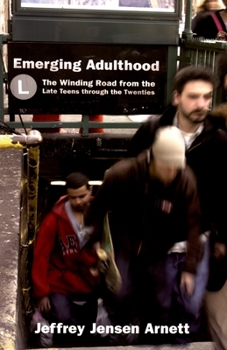
Emerging Adulthood: The Winding Road from the Late Teens through the Twenties


Select Format
Select Condition 
Book Overview
Recently the lives of people from age 18 to 29 have changed so dramatically that a new stage of life has developed, emerging adulthood, that is distinct from both the adolescence that precedes it and the young adulthood that comes in its wake. Rather than marrying and becoming parents in their early twenties, most people in industrialized societies now postpone these transitions until at least their late twenties, and instead spend the time in self-focused exploration as they try out different possibilities in their careers and relationships. In Emerging Adulthood, Jeffrey Jensen Arnett identifies and labels, for the first time, this period exploration, instability, possibility, self-focus, and a sustained sense of being in limbo. An increasing number of emerging adults emphasize having meaningful and satisfying work to a degree not seen in prior generations. Marrying later and exploring more casual sexual relationships have created different hopes and fears concerning long-term commitments and the differences between love and sex. Emerging adults also face the challenge of defending their non-traditional lifestyles to parents and others outside their generation who have made much more traditional choices. In contrast to previous portrayals of emerging adults, Arnett's research shows that they are particularly skilled at maintaining contradictory emotions--they are confident while still being wary, and optimistic in the face of large degrees of uncertainty. As the demographics of American youth, the American workplace, and adulthood continue to evolve, Emerging Adulthood is indispensable reading for anyone wanting to understand the face of modern America.
Format:Paperback
Language:English
ISBN:0195309375
ISBN13:9780195309379
Release Date:June 2006
Publisher:Oxford University Press
Length:280 Pages
Weight:1.15 lbs.
Dimensions:6.0" x 0.7" x 9.2"
Customer Reviews
5 ratings
General Review
Published by Thriftbooks.com User , 17 years ago
The book was in excellent shape as promised. The item did not get delivered as promised.
very interesting book
Published by Thriftbooks.com User , 17 years ago
Ever wonder why there are so many young adults who have no idea where they're going and no idea what to do with their lives? Those aimless drifters you encounter all too often? This book tells you why this is so. For me, the most interesting chapters are 6 & 7, the ones on the college experience and work experience. Here we find out how the current educational system is structured so as to NOT provide students with the help they need to find a suitable educational & career direction. I feel sorry for all those students who bob along like a cork in the ocean until, by sheer luck, they find their major. After graduation (or as Arnett points out, after flunking out or dropping out) they drift along some more and then eventually, 'fall' into the right job. Some never do any career exploration and never find their true calling. so sad. So much wasted time and so much wasted tuition money. Where are the high schools in all this? Where are the guidance counselors trying to help students discover their strengths/weaknesses and find a suitable job orientation? Nowhere, that's where. Overall, book is very good at showing the negative aspects of too much choice and too much freedom. I will have to deduct one star for Arnett's discussion of the causes of the 'emerging adult' phenomenon. In chapter one he incorrectly ascribes it to a rise in the median age of marriage & parenthood, amongst other factors. The increasing age of marriage is a SYMPTOM not a cause. The rise of emerging adulthood has to be due to the structural change in the U.S. economy over the past 50-60 years. He does, correctly, mention the other main driver: the birth control pill & sexual revolution and changing role of women in U.S. society. He covers the labor market change on pages 144-5 but, again, puts the cart before the horse when he writes "The rise of emerging adulthood has changed the nature of work for young people in their late teens and early twenties." No No No. This sentence should read "The changing nature of work has given rise to emerging adulthood for young people in their late teens and early twenties." He notes that those with a high school education have seen their real wages decline steeply from the early 1970s to the late 1990s. If he were to graph this and compare to his figure 1.1 (median US marriage age from 1950 to 2000) emerging adulthood can easily be explained - people are delaying marriage because in order to have a decent paying job they need more education than in the past. Marriage/parenthood and a post-secondary education are very difficult to combine as noted on p.154.
Very engaging and informative book
Published by Thriftbooks.com User , 20 years ago
The biggest surprise about Emerging Adulthood is that it wasn't published by a trade press -- it should have been. Although also chock full of great research, this is a very accessible and engaging read. The interviews with young people are suburb, as are the illustrations and the surveys on important issues. The "Twixter" phenomenon of young people taking longer to find their way has been around for awhile, and this is the first book to really capture it in all its facets. The chapter on religion alone is worth the price of the book -- it cuts through media hype about growing fundamentalism to show that actually, most young people aren't all that religious. Parents or teachers, buy this book if you want to understand your twentysomething kids. Twentysomethings, buy this book to see that you are not alone.
a critical guide to understanding years 18 to 25
Published by Thriftbooks.com User , 21 years ago
This book is a critical guide. It is useful for understanding the experiences, the challenges, and the potential of those who have left adolescence and have not yet entered adulthood. I have read this book thoroughly and have recommended it to many. As a professor of psychology, I assigned this book to my students last semester. The reviews of the book were unanimous-- Dr. Arnett 'has some how stepped inside my brain, experienced my 21-year-old life, and has written a book about exactly....me.'This book is not a self-help book, but instead provides emerging adults with research and information about development during these years. Students found the most helpful aspect of this book to be the way that Dr. Arnett has described emerging adulthood as a normative stage of development, rather than a cohort experience (think "Gen X") associated with low productivity and apathy. Many students have told me that their Baby Boomer parents found this book most helpful in understanding what their emerging adult children were going through. Students also told me that they "made" their friends and boyfriends and girlfriends read the book and that it helped them to understand what they were all going through collectively. If nothing else, this is a book that makes you think, encourages you talk, and really makes you want for more on this very interesting topic.
A "must" for parents
Published by Thriftbooks.com User , 21 years ago
I am the mother of two daughters, ages 22 and 17. I have always read parenting books in order to understand the stages of development my children were going through. But until Dr. Arnett's book came out, I knew of nothing to help me comprehend "emerging adulthood," a very confusing life stage I never experienced myself. (I knew exactly what I wanted to study when I started college, married at 21, and got a full-time job in my field immediately after graduation.) The attitudes of my older daughter and her friends often baffled me during her college years, and they continue to do so now that she has graduated. I was also surprised by the behavior I observed when visiting the university my younger daughter will be attending soon. In general, I try not to be judgmental or to give my children advice unless they ask for it. This strategy has worked well in the past. But until I read Dr. Arnett's book, I found it increasingly difficult to "keep my mouth shut" as I listened to my daughters talk about their lives. Now that I have read "Emerging Adulthood," I have more of a grasp on where my children are psychologically. The book has given me the tools to be a better mother. I think Dr. Arnett's work can be useful to emerging adults themselves by validating their own experiences. It can also be helpful to grandparents, who may find the behavior of their EA grandchildren incomprehensible.
Copyright © 2026 Thriftbooks.com Terms of Use
| Privacy Policy | Do Not
Sell/Share My Personal Information | Cookie Policy | Cookie Preferences | Accessibility Statement
ThriftBooks® and the ThriftBooks® logo are registered trademarks of Thrift Books Global, LLC
ThriftBooks® and the ThriftBooks® logo are registered trademarks of Thrift Books Global, LLC
