


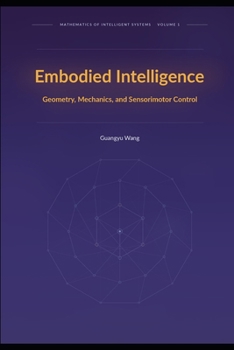
Embodied Intelligence: Geometry, Mechanics, and Sensorimotor Control
No Customer Reviews

Embodied intelligence begins where prediction meets the physical world. A learned policy may recognize the right object and choose the right action, yet still fail because of a frame mismatch, a delayed observation, actuator saturation, an unstable feedback loop, an unexpected contact, or a command that the body cannot execute. Embodied Intelligence: Geometry, Mechanics, and Sensorimotor Control develops the mathematics of these interfaces. Written as a graduate-level text, it unifies rigid-body geometry, mechanics, contact and friction, sensing and state estimation, action representations, constrained execution, feedback and stability, imitation learning, system identification, sim-to-real transfer, and closed-loop evaluation within a single systems perspective. Rather than treating robotics and machine learning as separate subjects, the book asks what must remain true as information passes from data and perception through a learned policy, an action head, a low-level controller, actuators, and contact with the world. A recurring manipulation system, worked examples, stress tests, computational labs, and carefully stated assumptions show how classical mathematics becomes directly relevant to modern robot learning and vision-language-action systems. The result is a mathematically rigorous but application-driven foundation for students, researchers, and engineers who want to understand not only whether an AI system can choose an action, but whether that action can be executed reliably, stably, and measurably in the physical world.
Format:Paperback
Language:English
ISBN13:9798907070653
Release Date:January 1
Publisher:Bestai Press
Length:212 Pages
Weight:0.64 lbs.
Dimensions:0.5" x 6.0" x 9.0"
Customer Reviews
0 rating
Copyright © 2026 Thriftbooks.com
Terms of Use | Privacy Policy | Do Not Sell/Share My Personal Information | Cookie Notice | Cookie Preferences | Accessibility Statement
ThriftBooks ® and the ThriftBooks ® logo are registered trademarks of Thrift Books Global, LLC
