


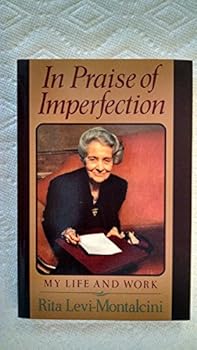
In Praise Of Imperfe


Select Format
Select Condition 
Book Overview
In Praise Of Imperfection: My Life And Work This description may be from another edition of this product.
Format:Paperback
Language:English
ISBN:0465032184
ISBN13:9780465032181
Release Date:October 1989
Publisher:Basic Books
Length:256 Pages
Weight:0.58 lbs.
Dimensions:8.0" x 0.8" x 5.5"
Customer Reviews
1 rating
NERVE GROWTH FACTOR QUEEN
Published by Thriftbooks.com User , 16 years ago
If you want to live to a 100, you might consider following Rita Levi-Montalcini's routine: get up at five in the morning, eat just once a day, at lunchtime, keep your brain active, and go to bed at 11pm. "I might allow myself a bowl of soup or an orange in the evening, but that's about it," she says. "I'm not really interested in food, or sleep." A diminutive, bird-like figure with an alert manner and engaging smile, Montalcini has the insight stamina and sharp intellect that someone half her age would envy. This astonishing woman - who studied medicine, survived Fascism and prejudice, and went on to win the Nobel Prize in 1986, still takes an active part in politics in the Italian Senate. I recently read her autobiography "In Praise of Imperfection:My Life and Work." What touched me was her ability to see the goodness in the people who she has shared her life with. A scientist, she advocated love as the life source of human existance, without exactly saying it that way. For example, I copied this quote from her book, a secondhand quote from Dutch Jewess Etty Hillesum:"My acceptance ( she worte in her diary July 1942, when she was already awareof her fate) is not resignation or lack of will: there is still r oom for elementary moral outrage against a regime which treats human beings this way. But the things that are happening to us are too big, too diabolic for one to react with personal rancor and bitterenss. It would be a peurile reaction, out of proportion to the fatefulness of these events. A future peace will be truly such only if everyone has first found it wihin themselves--if every man has freed himself of hatred for his fellows of whatever race or nation, and transformed it into something different, in the end into love, if that isn't asking for too much...That little piece of eternity which we carry within us can be expressed in one word or in ten volumes. I am a happy person and I celebrate this life in the year of our Lord 1942, the umpteenth year of war." Montalcini won the Nobel Prize for her study identifying the Nerve Growth Factor (NGF). Her NGF studies began with research on the growth of chicken embryo nerve fibers in Turin in the 1940s. Because of the Italian Fascist's anti-Jewish campaign, she was forced her to leave her university laboratory. Willful, ambitious, totally enthusiastic about her research, and not susceptible to intimidation, she created a research facility in her bedroom in Turin. She conducted her research, without stipends, while waiting out the tyrant government. In her autobiography Montalcini constantly revisits the question of `why people go bad?' She quotes Primo Levi: Considerate la vostra semenza: Fatti non foste a viver come bruti..." (Take thought of the seed from which you spring: you were not born to live as brutes.) For a scientist, it is a nearly impossible to rely on the humanities, sociology, or history to come up with an explanation for why humans commit atrocious crimes ag
Copyright © 2026 Thriftbooks.com Terms of Use
| Privacy Policy | Do Not
Sell/Share My Personal Information | Cookie Policy | Cookie Preferences | Accessibility Statement
ThriftBooks® and the ThriftBooks® logo are registered trademarks of Thrift Books Global, LLC
ThriftBooks® and the ThriftBooks® logo are registered trademarks of Thrift Books Global, LLC
