


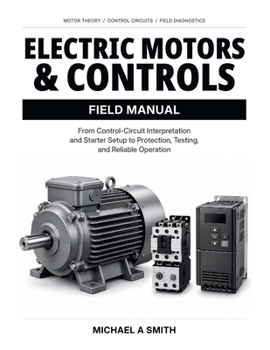
Electric Motors & Controls: Field Manual: From Control-Circuit Interpretation and Starter Setup to Protection, Testing, and Reliable Operation

Walk any industrial floor and count the motors - conveyor drives, pump sets, compressors, mixers, HVAC air handlers - and behind every one of them is a technician who can read its nameplate, trace its control circuit, and work out why it stopped. This field manual is built to make that technician you.
Motor and motor-control knowledge usually arrives in scattered pieces: one book covers theory, another covers sizing rules, another covers troubleshooting symptoms - and modern soft starters and variable frequency drives get left out entirely. That gap shows up at the worst moment: mid-shift, standing at a tripped motor control center bucket or a scorched nameplate, flipping between references and guessing at the next step.
Structured in four parts across eighteen chapters and six appendices, this manual follows the order the work actually happens in: motor theory and selection, conventional contactor-based control, contemporary control (soft starters, VFDs, motor control centers, and automation sensors), then installation, testing, troubleshooting, and preventive maintenance. Read it straight through as a course, or keep it within reach as a fast-lookup field reference.
With this field manual, you will be able to:
Read any standard motor nameplate with confidence - voltage, FLA, service factor, NEMA code letter, insulation class, and duty rating - and know exactly what each field controls.Work through full, step-by-step examples for sizing overload protection and branch-circuit conductors under NEC Article 430, estimating locked-rotor current from a code letter, and calculating a VFD's V/Hz ratio.Trace ladder diagrams, seal-in circuits, permissive chains, and timer-driven sequences using one consistent method throughout the book - and see how that same logic carries over into a PLC-controlled panel.Study soft starters and variable frequency drives at the same depth as conventional control, including starting profiles, constant-torque and constant-horsepower operation, and fault-code categories.Apply a repeatable, symptom-first troubleshooting method, backed by twelve quick-reference cards covering everything from "motor hums but won't start" to VFD and soft-starter fault conditions.Select the correct meter category rating and follow a verified absence-of-voltage ("prove dead") procedure before ever connecting a test lead to a live circuit.Build a tiered preventive maintenance program grounded in real condition-testing methods, rather than reacting to failures one at a time.Key topics include AC and DC motor fundamentals; single- and three-phase induction motor theory; motor selection, duty cycle, and enclosure ratings; control-circuit fundamentals and ladder logic; contactors, starters, and overload protection; timing relays, sequence and permissive logic, and the transition to PLC control; soft starters and variable frequency drives; motor control centers; sensors, interlocks, and automation; installation, commissioning, and testing; systematic troubleshooting; preventive maintenance; and a full appendix set covering NEC Article 430 sizing tables, wire and ampacity tables, a motor nameplate decoder, and a standard schematic symbol legend.
This book is written for industrial electricians, controls technicians, maintenance technicians, and apprentices who work on or around AC and DC motors and their control systems - whether learning this material for the first time or keeping a dependable reference within arm's reach on the job.
Add this field manual to your working library and use it the way it is built to be used - cover to cover as a structured course, or opened straight to the chapter or troubleshooting card the next real problem calls for.
Customer Reviews
ThriftBooks ® and the ThriftBooks ® logo are registered trademarks of Thrift Books Global, LLC
