


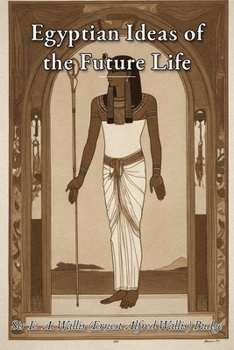
Egyptian Ideas of the Future Life

is a histor ical account likely written in the late 19th century. This work serves as the first volume in a series designed to provide an accessible overview of key aspects of ancient Egyptian beliefs, focusing on the concepts of resur rection and the afterlife as depicted in religious texts. The opening of the book presents an introduction and preface that outline the challenges of systematically tracing ancient Egyptian beliefs regarding the afterlife. Budge emphasizes that these beliefs evolved without a singular authoritative doc trine, reflecting a diverse range of texts from different historical periods. He highlights the central idea of immortality, which deeply influences Egyp tian burial practices and religious life. The text surveys the significance of the "Book of the Dead"asaprimarysource, revealing how various religious beliefs-ranging from the sublime to the superstitious-converged to form a complex view of resurrection and the future life that was pivotal to ancient Egyptian culture. A study of ancient Egyptian religious texts will convince the reader that the Egyptians believed in One God, who wasself-existent, immortal, invisi ble, eternal, omniscient, almighty, and inscrutable; the maker of the heav ens, earth, and underworld; the creator of the sky and the sea, men and women, animals and birds, fish and creeping things, trees and plants, and the incorporeal beings who were the messengers that fulfilled his wish and word. It is necessary to place this definition of the first part of the belief of the Egyptian at the beginning of the first chapter of this brief account of the principal religious ideas which he held, for the whole of his theology and religion was based upon it; and it is also necessary to add that, however far backwefollow hisliterature, weneverseemtoapproachatimewhenhewas without this remarkable belief. It is true that he also developed polytheistic ideas and beliefs, and that he cultivated them at certain periods of his his tory with diligence, and to such a degree that the nations around, and even the stranger in his country, were misled by his actions, and described him as a polytheistic idolater.
Customer Reviews
ThriftBooks ® and the ThriftBooks ® logo are registered trademarks of Thrift Books Global, LLC
