


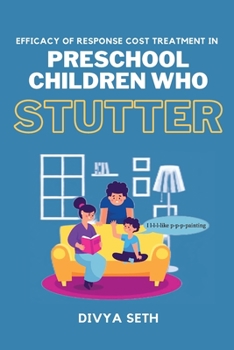
Efficacy of Response Cost Treatment in Preschool Children Who Stutter
No Customer Reviews

Stuttering is defined as "the disturbance or interruption in the effortless flow of speech" (Guitar, 2014). High prevalence rates of stuttering are reported in both children and adults (Gillespie & Cooper, 1973; Hall et al., 1976), particularly for preschool children (3.46%) in comparison to school-age and high-school-age children (0.84%) (Yairi & Ambrose, 2013). Further, the majority of the researchers reported the onset of stuttering to be during the preschool period, i.e., between 2 to 5 years of age (Andrews & Harris, 1964; Bernstein-Ratner & Silverman, 2000; Guitar, 2014; Johnson & Associates, 1959; Yairi & Ambrose, 1992, 2005). The risk of developing stuttering is believed to reduce as age increases (Craige et al., 2002). Low incidence rates after the age of 4 years and the spontaneous recovery from stuttering often seen in children (Yairi & Seery, 2015), are commonly associated with the decline in prevalence rate as the age progresses.
The nature of recovery in children has always been a conflicting debate among researchers. Natural or spontaneous recovery is suggested to be a noteworthy aspect of stuttering in young children (Yairi & Seery, 2015). A few of the earlier reports indicated that almost 30% to 40% of children recover from stuttering by the age of 8 years (Bryngelson, 1938), and 43% recover by the age of 14 years (Wingate, 1976). In the following years, researchers reported a much wider range of recovery rates between 32% (Johnson & Associates, 1959) and 89% (Yairi & Ambrose, 1992). Craige et al. (2002) reported 70% recovery over a lifetime. Though spontaneous recovery is common in young children who stutter (CWS), a significant number of these children continue to stutter and are prone to stuttering-related psychosocial problems.
The nature of recovery in children has always been a conflicting debate among researchers. Natural or spontaneous recovery is suggested to be a noteworthy aspect of stuttering in young children (Yairi & Seery, 2015). A few of the earlier reports indicated that almost 30% to 40% of children recover from stuttering by the age of 8 years (Bryngelson, 1938), and 43% recover by the age of 14 years (Wingate, 1976). In the following years, researchers reported a much wider range of recovery rates between 32% (Johnson & Associates, 1959) and 89% (Yairi & Ambrose, 1992). Craige et al. (2002) reported 70% recovery over a lifetime. Though spontaneous recovery is common in young children who stutter (CWS), a significant number of these children continue to stutter and are prone to stuttering-related psychosocial problems.
Format:Paperback
Language:English
ISBN:7634529710
ISBN13:9787634529718
Release Date:December 2022
Publisher:Independent Author
Length:156 Pages
Weight:0.48 lbs.
Dimensions:0.3" x 6.0" x 9.0"
Customer Reviews
0 rating
Copyright © 2026 Thriftbooks.com Terms of Use
| Privacy Policy | Do Not
Sell/Share My Personal Information | Cookie Policy | Cookie Preferences | Accessibility Statement
ThriftBooks® and the ThriftBooks® logo are registered trademarks of Thrift Books Global, LLC
ThriftBooks® and the ThriftBooks® logo are registered trademarks of Thrift Books Global, LLC
