


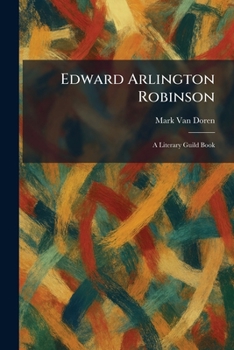
Edward Arlington Robinson: A Literary Guild Book

Select Format
Select Condition 
Book Overview
"Edward Arlington Robinson" is an insightful critical study and biographical exploration of one of America's most distinguished poets, written by the acclaimed scholar Mark Van Doren. This work delves into the stylistic nuances and intellectual depth of Robinson's verse, providing a comprehensive look at the man who became a three-time recipient of the Pulitzer Prize for Poetry.
Van Doren examines Robinson's unique position in the literary landscape, bridging the gap between traditional verse forms and modern psychological realism. The book provides a thorough analysis of his major works and thematic preoccupations, exploring Robinson's focus on human isolation, the complexities of character, and the search for spiritual truth in a shifting world. Through Van Doren's expert perspective, readers gain a profound understanding of Robinson's technical mastery and his significant contribution to the development of modern American poetry.
This volume serves as an essential companion for those seeking to understand the legacy of a poet known for his intricate portraits and profound observations on the human condition. It captures the essence of Robinson's literary voice while highlighting his enduring influence on the American literary tradition.
This work has been selected by scholars as being culturally important, and is part of the knowledge base of civilization as we know it. This work was reproduced from the original artifact, and remains as true to the original work as possible. Therefore, you may see the original copyright references, library stamps (as most of these works have been housed in our most important libraries around the world), and other notations in the work.
This work is in the public domain in the United States of America, and possibly other nations. Within the United States, you may freely copy and distribute this work, as no entity (individual or corporate) has a copyright on the body of the work.
As a reproduction of a historical artifact, this work may contain missing or blurred pages, poor pictures, errant marks, etc. Scholars believe, and we concur, that this work is important enough to be preserved, reproduced, and made generally available to the public. We appreciate your support of the preservation process, and thank you for being an important part of keeping this knowledge alive and relevant.
Customer Reviews
ThriftBooks ® and the ThriftBooks ® logo are registered trademarks of Thrift Books Global, LLC
