


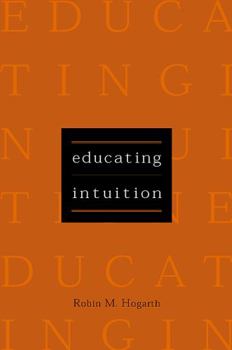
Educating Intuition


Select Format
Select Condition 
Book Overview
Every day we make intuitive decisions-from the mundane choice of what clothes to wear to more important issues such as which new car "feels right" or which person would be "good" for a particular job.... This description may be from another edition of this product.
Format:Hardcover
Language:English
ISBN:0226348601
ISBN13:9780226348605
Release Date:June 2001
Publisher:University of Chicago Press
Length:352 Pages
Weight:1.40 lbs.
Dimensions:9.0" x 1.1" x 6.0"
Customer Reviews
3 ratings
Groundbreaking review of research and theory.
Published by Thriftbooks.com User , 16 years ago
This volume is not for the casual reader. It is a serious review of the emperical literature and theory surrounding a facinating and controversial aspect of cogative psychology. Since Carl Jung first proposed Intuition as one of the four basic psychological functions, defining this elusive function has posed an ongoing chanellge. The author's oporational definition and review of existing research plus his own elaboration of a comprehensive information processing theory of the origens and functioning of Intuition constitute a major contribution to theories of cognative science.
First rate scholarship
Published by Thriftbooks.com User , 21 years ago
The role of the unconscious in decision making has become a topic of significant interest in recent years. This book is the best single source of information on this topic. R.Olsen, Decision Scientist.
Excellent book
Published by Thriftbooks.com User , 21 years ago
Hogarth shows that he is both a fastidious scientist and a great educator. He explains complicated concepts clearly. He also helps the reader jump around in his book to suit the reader's needs. If you want to either understand intuitive reasoning, or learn how people learn to do it better, this is the book to get. My job is to develop curriculum at the National Outdooor Leadership School (NOLS) and I find this book very helpful in looking at how people can learn to make better decisions in real field situations. John Gookin
Copyright © 2026 Thriftbooks.com Terms of Use
| Privacy Policy | Do Not
Sell/Share My Personal Information | Cookie Policy | Cookie Preferences | Accessibility Statement
ThriftBooks® and the ThriftBooks® logo are registered trademarks of Thrift Books Global, LLC
ThriftBooks® and the ThriftBooks® logo are registered trademarks of Thrift Books Global, LLC
