
Skip to content
Scan a barcode
Scan
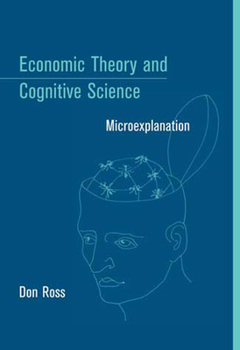
Paperback Economic Theory and Cognitive Science: Microexplanation Book

ISBN: 0262681684

ISBN13: 9780262681681

Economic Theory and Cognitive Science: Microexplanation

Select Format

Select Condition ThriftBooks Help Icon

Recommended

Format: Paperback

Condition: New

$55.55
50 Available
Ships within 2-3 days

Book Overview

In this study, Don Ross explores the relationship of economics to other branches of behavioral science, asking, in the course of his analysis, under what interpretation economics is a sound empirical science. The book explores the relationships between economic theory and the theoretical foundations of related disciplines that are relevant to the day-to-day work of economics--the cognitive and behavioral sciences. It asks whether the increasingly sophisticated techniques of microeconomic analysis have revealed any deep empirical regularities--whether technical improvement represents improvement in any other sense. Casting Daniel Dennett and Kenneth Binmore as its intellectual heroes, the book proposes a comprehensive model of economic theory that, Ross argues, does not supplant, but recovers the core neoclassical insights, and counters the caricaturish conception of neoclassicism so derided by advocates of behavioral or evolutionary economics.

Because he approaches his topic from the viewpoint of the philosophy of science, Ross devotes one chapter to the philosophical theory and terminology on which his argument depends and another to related philosophical issues. Two chapters provide the theoretical background in economics, one covering developments in neoclassical microeconomics and the other treating behavioral and experimental economics and evolutionary game theory. The three chapters at the heart of the argument then apply theses from the philosophy of cognitive science to foundational problems for economic theory. In these chapters, economists will find a genuinely new way of thinking about the implications of cognitive science for economics, and cognitive scientists will find in economic behavior, a new testing site for the explanations of cognitive science.

Customer Reviews

1 rating

An exploration of the fundamental blocks of economic science. Big subject, over-academic treatment.

Don Ross explores the tangled and much-argued relationship between economic theory and cognitive science and manages the feat of creating a cohesive perspective. Ever since the 1970s and the psychology experiments of Kahnemann & Tversky (which went on to win a Nobel Prize in economics - Kahnemann confessed he'd never in his life so much as studied Economics 101) the precepts of economics, based on the "rational man" have been under attack and the philosophical basis has been questioned. Is economics the product of atomised individual actions - or a social construct? What Don Ross does here is stand back and look at the fundamentals of economic theory, and attempts to cohesively tie things together. Is there a neat fit between the way humans tick and the way markets tick? The authority (and humour) of Ross' voice elevates this book above the sometimes shrill pop-marketplace of ideas, and this volume, all 450 pages of it, really sets out to establish a new milestone in economics: knocking down old theories and assumptions, and building out of this rubble a new platform. I don't think it succeeds. I feel Ross would have achieved a lot more if he had used a wider research scope. For the most part Ross' book is a meta-analysis of the work of other economic theorists including Philip Mirowski, Paul Samuelson and the author's own hero Daniel Dennett, and it really could have benefitted, if the author had incorporated, with little additional effort, more insights from the rapidly evolving ground of Cognitive Science. A shame, because the title of the book, and the subheading, promises this. As it turns out Ross doesn't appear comfortable delving into the realities of the human mind, and he prefers to wander back to the Departments of Economics and Philosophy where he clearly feels at ease. My second criticism is that he has produced some very, very heavy reading. Ross has some awful writing habits that could have done with a firm editor. So I blame the publisher as much as Don Ross. A good editor would surely have pulled out these things: - Strange metaphors (Tarzan anyone?) that distract rather than illuminate. - Constant use of acronyms (RPT, OISF, EGT...) which effectively encode rather than clarify the meaning of his long sentences. - Academic jargon. Example: "Eliminativism." This books is aimed squarely at his peers rather than at the intelligent public. The old My Fair Lady song "Why can't the English learn to Speak?" came to mind. "Why can't intelligent academics learn to communicate?" My guess is that Ross has been inspired by Dennett's own writing style, which is damned lively, but this author hasn't quite pulled it off. So I have very mixed views on this book. Even so, it deserves wider reading in the finance sector where the quants too often ignore the realities and irregularities of the humans who make up the market. But fasten your seatbelts. This is not an easy read.
Copyright © 2026 Thriftbooks.com Terms of Use | Privacy Policy | Do Not Sell/Share My Personal Information | Cookie Policy | Cookie Preferences | Accessibility Statement
ThriftBooks® and the ThriftBooks® logo are registered trademarks of Thrift Books Global, LLC

GoDaddy Verified and Secured