


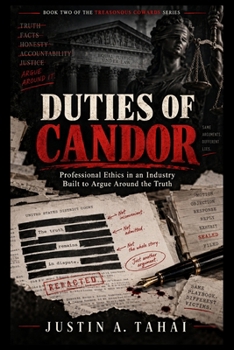
Duties of Candor

Honesty is not a premium feature.
Lawyers have rules against lying. DUTIES OF CANDOR asks what happens when following them becomes inconvenient.
Across thirty-five chapters, Justin A. Tahai examines professional ethics in an industry built to argue around the truth: courtroom statements, manufactured evidence, strategic delay, threats, supervision, client communication, fees, advertising, and the response when Bar Counsel starts asking questions.
A false statement does not resign when its author does. A continuance should not quietly become the decision. And the supervisor who apparently supervises by telepathy still has to explain what happened.
Blending Maine's professional-conduct rules, historical disciplinary decisions, fictional motions, and blistering satire, Tahai confronts the distance between the standard on the wall and the conduct defended in the room. The book follows the point where truth becomes expensive, correction becomes embarrassing, and an ordinary request for an answer becomes an extraordinary professional inconvenience.
The named cases retain their findings and sanctions. Mistakes are not automatically lies. Ethical breaches are not automatically crimes. Precision is not an apology; it is how an accusation survives examination.
This is not a demand for more courteous dysfunction. It is a demand that professional obligations govern the work, especially when they interfere with the preferred result.
Book Two of TREASONOUS COWARDS, DUTIES OF CANDOR leads into INSIDIOUS IGNORANCE and the concluding volume, ORGANIZED TREASON.
The rules were never supposed to be the performance. They were supposed to govern it.
Related Subjects
LawCustomer Reviews
ThriftBooks ® and the ThriftBooks ® logo are registered trademarks of Thrift Books Global, LLC
