


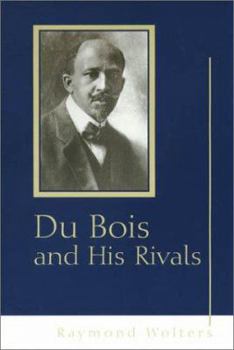
Du Bois and His Rivals


Select Format
Select Condition 
Book Overview
W. E. B. Du Bois was the preeminent black scholar of his era. He was also a principal founder and for twenty-eight years an executive officer of the nation's most effective civil rights organization,... This description may be from another edition of this product.
Format:Hardcover
Language:English
ISBN:0826213855
ISBN13:9780826213853
Release Date:January 1
Publisher:University of Missouri Press
Length:304 Pages
Weight:1.50 lbs.
Dimensions:9.0" x 1.3" x 6.0"
Customer Reviews
1 rating
Du Bois and the Nature of American Pluralism
Published by Thriftbooks.com User , 23 years ago
W.E.B Du Bois (1868-1963) was one of the leading and most controversial African-American leaders of the 20th Century. He received a PhD from Harvard and wrote in 1903 a short book, "The Souls of Black Folk", which remains an American classic. He wrote several scholarly works on African-American history which are still valuable. He helped found the NAACP and for many years edited its magazine, The Crisis, which worked agressively and tirelessly for civil and political rights for African-Americans. Near the end of his long life, Du Bois became embittered with the United States. He became a communist,, renounced his American citizenship, and died in Ghana in 1963 at the age of 95. In his informative and clearly-written history, Professor Wolters discusses the nature of Du Bois's accomplishment by discussing his relationships, his agreements and disagreements, with other African-American leaders of his day. The book is an important study of the history of black America (indeed of all America) and it sets out the many and varied approaches African-American leaders have used to bring justice to their people. Not surprisingly, it shows areas of agreement but also areas of strong disagreement and in-fighting. Professor Wolters contrasts Du Bois, with his emphasis on academic education and on agressive support of civil rights, with that of Du Bois's predecessor and rival, Booker T. Washington. He also stresses the large areas of agreement between the two men. Similarly, Wolters discusses Du Bois's reactions to Marcus Garvey, a black leader in the 1920's with broad mass appeal who tried to get American blacks to unite and establish a homeland in Africa. He points out that late in his career Du Bois came close to Garvey's position in many ways, involving African-American self-help from the bottom-up rather than from the top-down. Wolters then describes Du Bois's break with the NAACP and its leader Walter White. The break was occasioned by the NAACP's commitment to integration. Du Bois had moved away from this approach arguing instead that black Americans ought to work among themselves and within their community to achieve economic, political and social justice. Wolters gives a relatively brief treatment to Du Bois's final years. Wolters finds that a philosophy of pluralism governed Du Bois's efforts throughout his long career. Under his concept of pluralism, black Americans had two identities: an American identity and a black identity. He urged that blacks live in both worlds -- in other words, he urged African-Americans to share in the values of the American experience while creating their own uniquely black contribution to America and to civilization. Early in his career, Du Bois expressed his pluralistic vision as follows (Wolters, p.38): "One ever feels his two-ness,-an American, a Negro; two souls, two thoughts, two unreconciled strivings; two warring ideals in one dark body, whose dogged strength alone keeps it from being torn a
Copyright © 2026 Thriftbooks.com
Terms of Use | Privacy Policy | Do Not Sell/Share My Personal Information | Cookie Policy | Cookie Preferences | Accessibility Statement
ThriftBooks ® and the ThriftBooks ® logo are registered trademarks of Thrift Books Global, LLC
ThriftBooks ® and the ThriftBooks ® logo are registered trademarks of Thrift Books Global, LLC
