


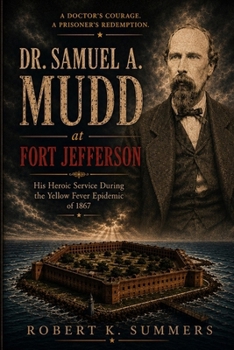
Dr. Samuel Mudd at Fort Jefferson

Dr. Samuel A. Mudd at Fort Jefferson
Convicted in the Lincoln assassination trial. Sentenced to life in a remote island fortress. Then an epidemic gave Dr. Samuel A. Mudd an unexpected chance for redemption.
In July 1865, four men convicted in connection with the assassination of Abraham Lincoln arrived under guard at Fort Jefferson, an immense brick fortress rising from a tiny island in the Dry Tortugas, nearly seventy miles west of Key West.
Dr. Samuel A. Mudd was one of them.
His crime had begun with an early-morning knock on his door. Hours after shooting President Lincoln, John Wilkes Booth arrived at Mudd's Maryland farmhouse with a broken leg. The country doctor treated him. Within weeks, Mudd was arrested, tried before a military commission, convicted of conspiracy, and sentenced to life imprisonment.
At Fort Jefferson, Mudd entered a world almost completely cut off from home. He endured oppressive tropical heat, hurricanes, insects, hard labor, and the uncertainty of whether he would ever see his wife and children again. After an unsuccessful escape attempt, he was placed in irons and confined with his fellow prisoners in the fort's dark and foul-smelling dungeon.
Then, in the summer of 1867, yellow fever came to Fort Jefferson.
The disease swept rapidly through the isolated garrison. When the post surgeon became ill and died, the imprisoned Maryland physician stepped forward to help care for the sick and dying. Mudd worked among the victims until he too contracted the disease and nearly died.
His actions transformed the way many of the soldiers at Fort Jefferson viewed him. Three hundred survivors signed a petition praising his courage and medical service and asking the government to restore him to liberty. The widow of the fort's surgeon also pleaded for his release, recalling Mudd's care for her husband, her son, and herself during the epidemic.
President Andrew Johnson finally pardoned Dr. Mudd in 1869.
Dr. Samuel A. Mudd at Fort Jefferson tells the remarkable story of those years-from the Lincoln assassination and conspiracy trial through Mudd's arrival at the Dry Tortugas, his attempted escape, imprisonment and daily life inside the fort, the catastrophic yellow-fever epidemic, and his eventual return to freedom.
The book also includes a photographic tour of Fort Jefferson, an examination of the famous 1936 motion picture The Prisoner of Shark Island, and a collection of important historical documents and later eyewitness accounts relating to Mudd and the assassination.
It is the story of a condemned prisoner, an isolated fortress, a deadly epidemic-and the extraordinary circumstances that gave one of the most controversial figures in the Lincoln assassination story a chance to save lives.
Customer Reviews
ThriftBooks ® and the ThriftBooks ® logo are registered trademarks of Thrift Books Global, LLC
