


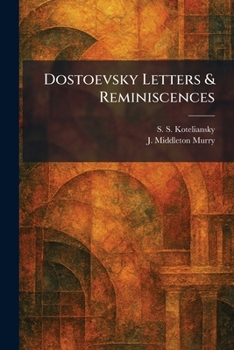
Dostoevsky Letters & Reminiscences

"Dostoevsky Letters & Reminiscences" provides a profound and intimate look into the life and internal world of Fyodor Dostoevsky, one of the most influential figures in world literature. This collection brings together personal correspondence and firsthand accounts that reveal the complexities of the man behind such masterpieces as "Crime and Punishment" and "The Brothers Karamazov". Through these documents, readers gain direct insight into Dostoevsky's creative struggles, his philosophical inquiries, and his personal relationships during the turbulent atmosphere of 19th-century Russia.
The volume includes essential letters to his wife and close associates, alongside poignant reminiscences that capture his character and daily life. These writings illuminate his views on religion, politics, and the psychological depths of the human condition, which served as the foundation for his literary output. Translated by S. S. Koteliansky and J. Middleton Murry, this work is an indispensable resource for scholars and enthusiasts of Russian literature, offering a rare window into the private thoughts and experiences of a literary titan whose exploration of the soul continues to resonate today.
This work has been selected by scholars as being culturally important, and is part of the knowledge base of civilization as we know it. This work was reproduced from the original artifact, and remains as true to the original work as possible. Therefore, you may see the original copyright references, library stamps (as most of these works have been housed in our most important libraries around the world), and other notations in the work.
This work is in the public domain in the United States of America, and possibly other nations. Within the United States, you may freely copy and distribute this work, as no entity (individual or corporate) has a copyright on the body of the work.
As a reproduction of a historical artifact, this work may contain missing or blurred pages, poor pictures, errant marks, etc. Scholars believe, and we concur, that this work is important enough to be preserved, reproduced, and made generally available to the public. We appreciate your support of the preservation process, and thank you for being an important part of keeping this knowledge alive and relevant.
Customer Reviews
ThriftBooks ® and the ThriftBooks ® logo are registered trademarks of Thrift Books Global, LLC
