


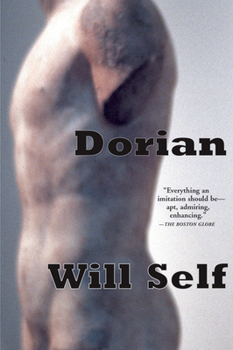
Dorian


Select Format
Select Condition 
Book Overview
Will Self's DORIAN is a "shameless imitation" of Oscar Wilde's The Picture of Dorian Gray that reimagines the novel in the milieu of London's early-80s art scene, which for liberated homosexuals were a golden era of sex, drugs and decadence before the AIDS epidemic struck later in the decade. It is "an age in which appearances matter more and more and more. Only the shallowest of people won't judge by them." Young Dorian Gray, just out of school, is a trust funded, impressionable Adonis-like blonde with none of the cynicism of the characters who end up corrupting his innocence even as they love him for it. He arrives in London to help socialite and philanthropist Phyllis Hawtree with her project of running a shelter for young drug addicts. He knows he is strikingly beautiful, that he could be a male model, but he tries not to get too caught up in the "looks thing." Basil Hallward, an artist friend of Phyllis's son Henry Wotton, meets Dorian and immediately falls for him, asking him to pose for a video installation called Cathode Narcissus, wherein Dorian is surrounded by nine television monitors which project images of himself looking into a mirror. In the book's final pages, we discover that Dorian is so taken by the images that he makes a wish that they will age while he remains eternally young. And indeed, Dorian soon swears he sees some faint traces of aging in the images. Meanwhile Dorian is so impressed with the witty, sophisticated banter between Baz and Wotton that he immediately wants to be part of their world (he is described as a social chameleon, easily slipping into the characteristics and fashions and mannerisms of those around him). Dorian, then, breaks up with his college girlfriend and takes up with Baz's friend Wotton, a rich, intelligent but affectless homosexual boozer and cokehead (and careless Jaguar driver) who has a loveless marriage of convenience with the socialite Lady Victoria, a somewhat batty woman who is fine to live in denial of her husband's sexuality so long as their marriage keeps bringing in a flood of party invitations. Jealous of Baz's affections for Dorian and eager to see Dorian "thoroughly pleasure this jaded century" via his unparalleled looks and money, he takes Dorian under his wing and Dorian soon grows to prefer the wild, devil-may-care Wotton over the earnest, somewhat pretentious Baz. ("Baz Hallward the wayward acolyte, seething with energy and bumptiousness; while the younger man Wotton] played the part of his mentor, consumed with cool, eaten up with indifference.") "Dorian knew his own limitation: he had money but no real style. His upbringing had been here and there, on the fringes of film sets, in foreign hotels ] It had given him polish but no shine. He lacked the deep lustre of someone like Wotton." But in truth, Wotton is no better himself: "Henry Wotton was subject to saying to anyone who would listen that the chameleon is the most significant of modern types." And while outer appearance would seem to belie this, the truth was that beneath the Planet of Wotton was a realm of complete flux." The characters to which Wotton introduces Dorian are no better: drug addicts who revere Dorian only for his looks and money. As Dorian gets caught up in this world he becomes every bit as superficial as these people: "Dorian had begun to display talents in the only two areas of life that are worth considering, he was becoming a seducer par excellence, and he was transforming himself into an artificer of distinction, a person who is capable of employing all of the objective world to gain his own end." He eventually falls for a junkie named Herman largely for his beautiful black skin. To celebrate the debut of Cathode Narcissus, Dorian invites Herman over for an orgy with Wotton, Baz, and the others although not as jaded as Dorian has become (and apparently not a homosexual), Herman's craving for drugs is such that he agrees, and at the party he shares a needle with the other attendees and unwittingly infects them with AIDS. After the party, perhaps because he is ashamed of what he has sunk to, he kills himself in the street. PART TWO: TRANSMISSION Ten years have passed, and Henry Wotton now lies in a hospital bed on the AIDS ward. He knows he is dying, as is his friend Baz who visits him now for the first time in years, but unlike Baz, Wotton has continued to live the life that brought him down, bribing the hospital employees to let his dealer visit him. His wife is in absolute denial, calling Wotton (TM)s infection a oebug. ? Baz becomes angry that Wotton is not taking care of himself (having been clean for five years, Baz has recovered his soul). He tells Wotton about his move to New York City in the early eighties, when Manhattan was oeat the very peak of a great mountain of depravity. ? His drug habit drove him to poverty and homelessness and he eventually ended up an errand boy for three transvestite cabaret acts who housed him in their squaliiiiiid apartment. Dorian found him here and oesaved ? him by cleaning him up and taking him shopping so that Baz might introduce him to some of his downtown connections (Warhol, Mapplethorpe, Burroughs, etc.) This doesn (TM)t really happen, but Dorian does manage to oeput himself at the center of every season, ? ever-popular for his looks, fake refinement, and money. oeHis social promiscuity and his sexual promiscuity have had the same bewildering effect "that of making him incomprehensible, unknowable. Is he gay or straight? Is he nob or yob? And incidentally, how old is he exactly? ? Dorian discovers gay nightlife, sleeping with hundreds (maybe thousands) of men and in one brutal instance he later recalls with glee, beating a man to death as he sodomizes him in the basement of the Mineshaft nightclub. Eventually, however, when the AIDS scare begins, Dorian popularity lessens when many suspect that he is knowingly transmitting the disease. When Wotton returns fr
Format:Paperback
Language:English
ISBN:B007CV45CE
ISBN13:9780802140470
Release Date:January 2004
Publisher:Grove Press
Length:288 Pages
Weight:0.82 lbs.
Dimensions:0.8" x 5.5" x 8.3"
Related Subjects
Contemporary Fiction Gay Literary Literature & Fiction Psychological Thrillers ThrillersCustomer Reviews
5 ratings
Many people just don't like this sort of stuff...
Published by Thriftbooks.com User , 20 years ago
...but I'd rather be one of the few who finds pleasure in Self's perversity than one of the many who see only perveristy in such pleasures (as those of the wanton that is Self's Henry Wotton). Perhaps you should skip this tale if you: ) rarely find reinterpretations as enjoyable -- note that this is not the same as 'good' -- as an original or 'classic' ) are offended by repeated discussions of drugs, sex, homosexuality, precious bodily fluids, et cetera ) haven't read any of his other works; or have, and don't like such ) don't like it when authors make much wordplay or use obscure vocabulary which might require the reader to visit a dictionary Note: I am a big fan of Mr. Self. You also may find his writing very entertaining if you don't fall into any of the above buckets. If you're interested in checking for yourself, I would recommend the short story collection _Grey Area_ or the novel _Great Apes_. (The only major book of his that I did not find highly enjoyable was _How the Dead Live_, which was a little tedious.) So there you have my opinion. It's just that. But do take the reviews of those who panned this book as such as well. There's no accounting for taste; however, I personally recommend that you taste this account of a modern Dorian Gray. Terrible, I know;).
Narcissism, surely the scourge of our age
Published by Thriftbooks.com User , 21 years ago
It was years ago that I read the Wilde classic, so I wasn't as I read Will Self's update consciously or otherwise thinking about the differences between the two and judging how it measures or fails to measure up to its more famous predecessor. Perhaps that's one of the reasons why I enjoyed it while many others disliked it. As a standalone novel about narcissism - surely a contemporary social ill, if not the scourge of our age - I thought "Dorian" stood its own ground very well. Self doesn't pull his punches in his depiction of the dissolute lifestyle of the upper classes. He seethes with barely concealed contempt for their amorality and their never-ending drug and sex orgies. There's not one sympathetic character among the lot. They're careless and callous of life - they dismiss somebody else's death by murder with the wave of a limp wrist - so when they catch AIDS and find the dagger pointing at their own throats, should anybody baulk ? Dorian is only the distillate and the end result of a values system that encourages if not promotes self worship. Self's excessive wordplay - headache inducing as always - is only quintessentially Self. I'm sure he's added liberally to the English language. His graphic, no holds barred take on decadence is often unpleasant and shocking. His narrative technique is sometimes confusing as he takes us backwards and forwards in time, juxtaposing past events alongside current occurrences through the use of bedside confessions. We confront our horror just as the tale reaches its nadir when Dorian confuses himself with his airbrushed video images. The rest, as they say, is history. "Dorian" isn't for everyone. It's nasty, graphic and violent but also eerily contemporary and necessary.
Brilliant
Published by Thriftbooks.com User , 21 years ago
Other reviewers' complaints about this novel typically focus on what is graphically unpleasant about Self's depictions of his characters. Well, wake up. It isn't 1959 anymore, when this complaint was raised about William Burroughs's novel Naked Lunch. Will Self has created an extraordinarily inventive, imaginative rewriting of Wilde's novel, set in the 1980s and '90s. Only a writer as talented as Will Self could have achieved this re-vision so successfully. The novel is filled with brilliant one-liners, and the plot and characters have also been brilliantly re-imagined. Anyone who is bored by the tiresome "cleverness" of contemporary gay American fiction, with its endless pseudo-dilemmas (how is the protagonist supposed to choose between the cute do-gooder and the devilishly handsome studster who keeps tempting him?) will be grateful to be able to read a novel in which plot, character, and style actually conspire together to create something truly thoughtful and lasting.
Confusing
Published by Thriftbooks.com User , 21 years ago
This novel is at best confusing but still intriguing. Most of the time you aren't quite sure what is happening, since the book has a tendency to jump around a bit. But what I had loved it for was that it had captured the decandency of the original. Also was quite surprised too that Lord Henry Wotton was a bigger villain in this piece than the original. I loved the surprise ending.
A New Perspective on Dorian Gray
Published by Thriftbooks.com User , 22 years ago
Judging by its title, I at first thought that Will Self had in mind the ambitious goal of writing a viable version of "The Picture of Dorian Gray" set in the age of AIDS and drugs, while at the same time daring the reader to compare his novel to the original. To set himself up for this inevitable comparison with a master like Wilde, he pulls the reader in from the very beginning with his spectacular stylistic prowess. Though quite faithful to the original, he soon transcends it and uses the Dorian Gray story as an instrument in an exploration of the uneven flow of time, and of the interplay between physical time, historical time and biological time.Youth, venerated almost religiously in our days, is of course defined in terms of biological time, and when the flow of biological time comes to a standstill in Dorian, some form of time keeps flowing on in the artistic rendering of Dorian, the painting in Wilde, the video installation in Self. This artistic rendering is the one that provides a picture of our age for future generations, and thus the time that flows in it is historical time. By contrast the lifestyle of the Wottons and their friends gives the appearance of historical time at a standstill, while biological time is flowing inexorably, driving many of these people to early deaths by disease (mainly AIDS) originating in this very lifestyle. Maybe Mr. Self's most original creation is Henry Wotton's neighbor, the "jiggling man" who metes out the seconds of physical time for Wotton's existence.Whether reading Wilde or Self, the picture/installation is an extremely clever, but also an extremely contrived device. Will Self deals with this problem by attaching a both shocking and very ingenious epilogue in which everything that has gone before is revealed to have been fiction written by Henry Wotton. This fiction in turn has an immense impact on Dorian Gray's "real" life and in the last ten pages or so the interplay between fiction and reality --- or more precisely between a fiction within a fiction and a reality within a fiction --- becomes the main focus. This is a very interesting and major issue in its own right, and this epilogue does not do it justice, nor could it. With all his ingenuity Will Self has overloaded the book. The same can be said also about his clever but excessive use of Wilde type epigrams. As an example, he has Wotton commenting on Baz' death with the following paraphrase of Lady Bracknell ("The The Importance of Being Earnest") "For Baz to have died once would have been unfortunate; for him to die twice looks like carelessness." I found this funny but also over the top.These problems aside, "Dorian" is a thought-provoking and extremely well-written novel well deserving the reader's attention.
Copyright © 2025 Thriftbooks.com
Terms of Use | Privacy Policy | Do Not Sell/Share My Personal Information | Cookie Policy | Cookie Preferences | Accessibility Statement
ThriftBooks ® and the ThriftBooks ® logo are registered trademarks of Thrift Books Global, LLC
ThriftBooks ® and the ThriftBooks ® logo are registered trademarks of Thrift Books Global, LLC
