


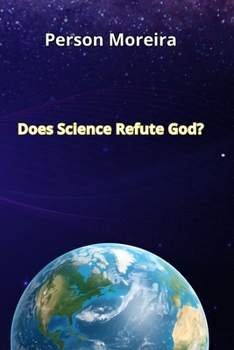
Does Science Refute God?

Has science made faith in God obsolete? For centuries this question has been answered with slogans in place of arguments, with faith reduced to a comfort for the ignorant and science paraded as the natural endpoint of every belief. Written in the voice of a scientist who openly confesses his faith, this book enters that tension and refuses both caricatures. It offers a calm, rigorous, and intellectually honest conversation between reason and transcendence, shaped over years of study in laboratories, libraries, and the hard questions that neither side likes to face.
Across twelve chapters, the reader travels from the limits of the scientific method to the frontiers of modern physics, cosmology, and biology. The great names of twentieth-century science, among them Einstein, Heisenberg, Planck, and Dirac, appear here as witnesses to a mystery that only deepened as their understanding advanced. The book examines the fine adjustment of the physical constants, the strange fact that the universe is comprehensible at all, the genetic code that reads like written language, and the philosophical weight of human experience. The argument is presented in accessible language, yet it asks for maturity: it accumulates slowly, without shouting and without easy formulas, until the hypothesis of a Creator becomes difficult to set aside.
This is a book for the skeptic who respects a serious argument, for the believer who wants a faith able to withstand scrutiny, and above all for the young reader entering the academic world under pressure to treat belief in God as intellectual weakness. It asks no one to agree in advance. It asks only for an open mind and the willingness to follow the questions wherever they lead. Those who reach the final page may not change their conclusions, yet the question of God will feel more alive, more serious, and more worthy of respect than before.
Customer Reviews
ThriftBooks ® and the ThriftBooks ® logo are registered trademarks of Thrift Books Global, LLC
