


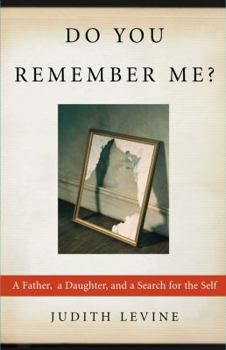
Do You Remember Me?: A Father, a Daughter, and a Search for the Self

Select Format
Select Condition 
Book Overview
In her award-winning book Harmful to Minors, Judith Levine radically upended our fixed ideas about childhood. Now, she tackles the other end of life in this poignant memoir of a daughter coming to... This description may be from another edition of this product.
Format:Hardcover
Language:English
ISBN:074322230X
ISBN13:9780743222303
Release Date:May 2004
Publisher:Atria Books
Length:320 Pages
Weight:0.95 lbs.
Dimensions:8.4" x 1.1" x 5.5"
Customer Reviews
5 ratings
Really thoughtful, very helpful
Published by Thriftbooks.com User , 22 years ago
Just want to strongly echo the other reviews. Loved her thoughtfulness about dementia, relationships and family - and honestly, found it very helpful for thinking about and relating to my aging parents (early 80's) who do not have Alzheimers, but are certainly getting older. A very respectful and loving book, smart. Recommend it a LOT.
Why You Should Read Levine's Story about Dementia
Published by Thriftbooks.com User , 22 years ago
I got a great deal out of reading Levine's fascinating book about her father's dementia. It made such compelling reading that the book was hard to put down. What I especially admired was Levine's skillful combining of autobiographical detail and informed discussion of dementia. The two aspects of the book flowed into each other: the autobiographical details provide evidence for Levine's take on debates about dementia. She's fully informed about these debates having read both neuroscientists and psychologists and more on the issue. She is thus able to discuss the science involved without overwhelming the reader.Second, as with many others I'm sure, elements of Levine's story resonated with my experiences with relatives who are aging. Levine's understanding of dementia and her description of the problems of assisted living were illuminating. Third, I was persuaded by Levine's view of dementia, and the side she takes in ongoing debates. While in no way denying the biological changes in the brain that go with aging, Levine shows that the way a person reacts to neurological changes (the tangled plaques, etc) depends on her context-on her social and emotional environment. Also, how others respond to one's aging determines one's vulnerability to dementia. This very much fits in with my interest in the social construction of "aging," and in how age discourse impacts on those of us, indeed, aging, from the marketing geared to this group to the continued dismissal and marginalizing of the elderly in a youth-obsessed culture. Levine's analysis of the Cartesian model and what's wrong with it resonates very much with new work by Teresa Brennan, in her posthumous Transmission of Affect. Reader's of Levine's book might appreciate reading Brennan. Finally, Levine's discussion of the caregiver and different expectations of this role, different possibilities of the role, was very informative.Levine's openness about her family and personal life is remarkable and draws the reader in. I was fascinated with drama that emerges in Levine's relationship with her mother, and appreciated the irony that Levine could get closer to her father once he could no longer provoke intellectual battles with his daughter: This supports Levine's view that the rational, individual self of the western enlightenment omits many other important ways of being, loving and knowing.Levine's writing throughout does not get in the way of what she's saying, which, for me, is the highest praise one can give about any writing.I appreciated the opportunity to read this book. It should be mandatory reading for every social worker, doctor and caregiver!
This book has it all
Published by Thriftbooks.com User , 22 years ago
A memoir of a New York leftwing Jewish family, a social science analysis of aging and dementia, a thoroughgoing psychological self-analysis - this book really has it all. The story was occasioned by Levine's father's Alzheimer's, but it goes in many fascinating directions to dwell on human relationships, change and growth. Levine, whose previous books I also thoroughly enjoyed for their combination of passionate politics and tremendous writing talent, has bitten off a lot with this memoir, but she is up to the task. I gained an appreciation for dementia I lacked before, and I am actually much less afraid of the subject - this is quite an achievement! The book is as engrossing as a novel, and instead of studiously underlining in my usual fashion, I found myself turning pages eagerly without worrying that I would forget the important points. I am going to recommend this book to several reading groups - and I am confident that they will thank me! This is a really humanistic work and it deserves a wide audience.
Do You Remember Me?
Published by Thriftbooks.com User , 22 years ago
With great honesty and insight, Judith Levine chronicles complicated and painful family relationships. These intertwine in the struggle to understand and deal with her father's downward spiral into the world of Alzheimer's. The important message at the end of the author's arduous journey is that the soul of the individual, the self, is ever viable and needs to be respected and nourished while going in new and uncharted directions. I highly recommend this timely, sensitive, and well-researched book which is both moving and provocative.
Great book!
Published by Thriftbooks.com User , 22 years ago
Do You Remember Me isn't just about Alzheimer's. I could hardly put it down, even though no one in my family or anyone I know well has ever been diagnosed with this malady. Levine's book is funny, poignant, flinty, tender, and very moving. On a deep and affecting level, it's about the struggles we all go through to remain generous, loving and connected in a world that, more and more, pressures us to shut down emotionally and look out solely for Number One. I read this book over a week ago and am still thinking about it.
Copyright © 2026 Thriftbooks.com
Terms of Use | Privacy Policy | Do Not Sell/Share My Personal Information | Cookie Notice | Cookie Preferences | Accessibility Statement
ThriftBooks ® and the ThriftBooks ® logo are registered trademarks of Thrift Books Global, LLC
ThriftBooks ® and the ThriftBooks ® logo are registered trademarks of Thrift Books Global, LLC
