


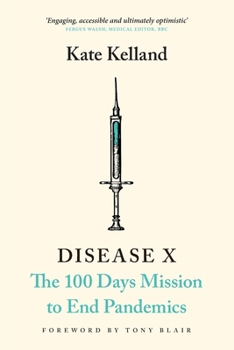
Disease X: The 100 Days Mission to End Pandemics

Select Format
Select Condition 
Book Overview
What if the next global pandemic isn't a replay of COVID-19, but something faster, deadlier, and harder to stop? In 2018, the World Health Organization added a chilling new entry to its list of priority epidemic threats: "Disease X" - a placeholder for the unknown pathogen that could trigger a serious international outbreak.
In Disease X, science journalist and CEPI (Coalition for Epidemic Preparedness Innovations) insider Kate Kelland takes you behind the scenes of pandemic preparedness, global health security and vaccine innovation. With rare access to the people building the world's defences, Kelland shows how we can spot a new virus early, respond at pandemic speed, and deliver safe, effective, globally accessible vaccines in as little as 100 days.
This is gripping pandemic nonfiction that reads with the urgency of a medical thriller, but it's grounded in evidence, history, and the hard lessons of the COVID-19 pandemic: exponential spread, R0, variants, overwhelmed hospitals, lockdowns, and the staggering human and economic costs.
Inside you'll explore:
Why emerging infectious diseases and zoonotic spillover (from bats, birds, primates and other wildlife) make future epidemics more likely: SARS, MERS, Ebola, Zika, Nipah, Marburg, Lassa, bird flu and swine fluHow pandemic response fails when leaders "wait and see," and how it succeeds when decision-makers act fast through the fog of warThe 100 Days Mission: a bold roadmap to compress vaccine R&D from genetic sequencing to clinical trials, manufacturing scale-up and rapid rolloutThe technologies powering next-generation vaccines and therapeutics: mRNA, viral vectors, plug-and-play platforms, rapid testing, and global genomic surveillanceWhy speed requires risk: funding multiple candidates "at risk," accepting failures, and building a portfolio-because luck is not a strategyThe essentials of outbreak control: early warning systems, data sharing, public-private partnerships, supply chains, equitable access, and protecting low- and middle-income countriesYou'll meet the real-world pandemic worriers, virus-watchers, scientists and policy insiders who helped launch fast vaccine programmes and the global push for a prototype vaccine library - work designed to shorten the time from pathogen discovery to protection.
Customer Reviews
ThriftBooks ® and the ThriftBooks ® logo are registered trademarks of Thrift Books Global, LLC
