


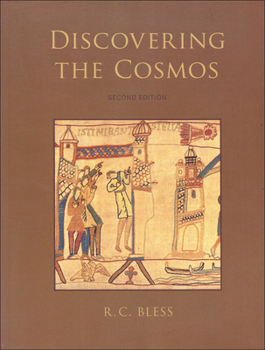
Discovering the Cosmos

Select Format
Select Condition 
Book Overview
Thisbook provides a rich, historical approach to introductoryastronomy. It is ideal for use in an introductory astronomycourse for nonmajors.
Based on the very popular liberal arts course Bob Bless has taught at University of Wisconsin for many years, this book provides a rich, historical approach to introductory astronomy. It is ideal for use in an introductory astronomy course for nonmajors. In the fifteen years since the first edition of this text was published, several new concepts such as dark matter, dark energy, and an incredible expansion of the universe (inflation) have been developed. Furthermore, many of the exotic effects predicted by General Relativity (e.g. black holes, warped space) have gone from being interesting theoretical speculations to useful practical tools for understanding the universe. This book aims to give an overview of astronomy, but in such a way that the non-science major can get a feeling for how science actually developed with its false starts and wrong turns, which observational evidence eventually corrected, and also to describe the incredible recent developments in our understanding of the physical universe. Several chapters of this 2nd edition have been extensively revised to include these recent developments.Because it has become increasingly difficult to "cover" all of astronomy in a one-semester course, this edition has largely omitted coverage of the physical nature of the objects in our, and other, planetary systems, although a discussion of the possibility of life elsewhere closes the book.
Based on the very popular liberal arts course Bob Bless has taught at University of Wisconsin for many years, this book provides a rich, historical approach to introductory astronomy. It is ideal for use in an introductory astronomy course for nonmajors. In the fifteen years since the first edition of this text was published, several new concepts such as dark matter, dark energy, and an incredible expansion of the universe (inflation) have been developed. Furthermore, many of the exotic effects predicted by General Relativity (e.g. black holes, warped space) have gone from being interesting theoretical speculations to useful practical tools for understanding the universe. This book aims to give an overview of astronomy, but in such a way that the non-science major can get a feeling for how science actually developed with its false starts and wrong turns, which observational evidence eventually corrected, and also to describe the incredible recent developments in our understanding of the physical universe. Several chapters of this 2nd edition have been extensively revised to include these recent developments.Because it has become increasingly difficult to "cover" all of astronomy in a one-semester course, this edition has largely omitted coverage of the physical nature of the objects in our, and other, planetary systems, although a discussion of the possibility of life elsewhere closes the book.
Format:Paperback
Language:English
ISBN:1891389718
ISBN13:9781891389719
Release Date:March 2013
Publisher:University Science Books
Length:728 Pages
Weight:0.30 lbs.
Dimensions:1.0" x 8.3" x 10.7"
Customer Reviews
1 rating
Excellent Introductory Text for the Advanced Student
Published by Thriftbooks.com User , 20 years ago
Bless' Discovering the Cosmos is an excellent introductory astronomy text for students with a more advanced preparation either in the physical sciences or in mathematics. The text focuses more towards the stellar and galactic aspects of modern astronomy though there are sections on historical astronomy and planetology. While the book is does not cover the up-to-the-minute advances in astronomy, this can easily be filled in with web-based sources that build upon the excellent foundational material. The book's great strength is that it doesn't shy away from using the science and mathematics a student who has competently passed a high school chemistry and algebra II class should have learned. While this limits the text's use in general introductory astronomy survey courses at the college level it makes for a much richer source for honors or advanced courses at either the college freshman or the high school senior level. Educators with a solid background in the sciences will find this text a treasure trove of information that can serve as a place to pull additional information when trying to understand or expand curriculum.
Copyright © 2026 Thriftbooks.com
Terms of Use | Privacy Policy | Do Not Sell/Share My Personal Information | Cookie Notice | Cookie Preferences | Accessibility Statement
ThriftBooks ® and the ThriftBooks ® logo are registered trademarks of Thrift Books Global, LLC
ThriftBooks ® and the ThriftBooks ® logo are registered trademarks of Thrift Books Global, LLC
