Picture the Mesozoic world of 150 million years ago. It has a warm and semiarid climate subject to seasonal variations. Vegetation is generally sparse; however, along stream banks and lakes, the plant life is dense. Volcanoes and earthquakes shake the region, but the ground vibrates for other reasons as well: great herds of dinosaurs are constantly on the move across the basin in search of food, water, and mates.
At a plant cluster, a DIPLODOCUS stops for nourishment. It is a majestic creature, thirteen feet high at the hip and weighing seventeen tons. A long, narrow skull with small pencil-like teeth perches atop an elongated neck. Rather than stretching for the topmost foliage, the DIPLODOCUS moves slowly and infrequently, sweeping its head from side to side while nibbling at the leaves of low-growing shrubs. Occasionally, it raises its head to reach a particularly succulent leaf, to scan the horizon for predators, or to check the position of the herd.
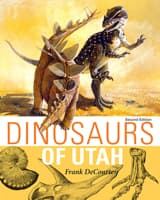
Although images of the dinosaurs exist only in our imagination, scientists are able to hypothesize the appearance, size, and habits of the giant reptiles by studying nature's autobiography--the rock record--which contains both fossils and trace fossils (footprints and skin impressions, for example). Because Mesozoic rock covers over 25,000 square miles in Utah, the state is a natural museum of the great age of dinosaurs. DINOSAURS OF UTAH, a comprehensive account of "Utah's" dinosaurs, uses extensive research performed in Utah's natural museum to describe dinosaur anatomy, feeding, reproduction, and social behaviors in the context of the changing geological record. Seventy-five drawings help illustrate fossils and dinosaur anatomy while twenty-five color photographs depict the sites and geological environments described in the text. Twenty-two spectacular color paintings commissioned specifically for this book capture the spirit of these animals in the most accurate renditions of dinosaurs to date.
DINOSAURS OF UTAH enlivens our understanding of these amazing creatures by explaining them and their world to us. It moves beyond the superficial representations of dinosaurs so prevalent today to more accurately portray the variety of dinosaurs that once roamed in the region now known as Utah. Through the lens of this book, we can travel backward in time to view a landscape millions of years old. This description may be from another edition of this product.
Of interest to anyone who likes dinosaurs, not just those found in Utah!
By Thriftbooks.com User, May 31, 2008
_Dinosaurs of Utah_ is a book that author Frank DeCourten first conceived of in the late 1980s while teaching a course on dinosaurs at the University of Utah. He had envisioned a book that would collect all of the latest information on Mesozoic Utah with most of the focus being on dinosaurs and after years of work was able to publish this well-illustrated book in 1998. Though the book is titled _Dinosaurs of Utah_ it will be of use to anyone interested in paleontology and particularly in dinosaurs. The first chapter was an overview of the Mesozoic world as a whole, with particular emphasis on non-dinosaur fauna, paleogeography, and geology of the Mesozoic. It was interesting to learn how unusual Mesozoic geology was; normally the polarity of the Earth's magnetic field reverses itself about every one-half million years but for some reason about 118 million years ago the magnetic field shifted from reverse to normal and stayed that way for 35 million years ago. The reasons for this unique event are not understood; are they connected to the intense volcanism of the Mesozoic? More igneous rock formed both on the surface and underground in the Cretaceous than during any other geologic period. It was also interesting to learn that the ocean's circulation systems were quite different back then; today's circulation of water in the deeper ocean basins is driven by frigid polar water sinking and continuously displacing warmer, less dense water on the abyssal plains. With no cold polar waters, were the deepest ocean waters stagnant, oxygen-starved, and virtually lifeless? Chapter two was a pretty basic chapter as one can guess from its title, "What is a dinosaur?" Chapter three looked at the Triassic. Early Triassic Utah, as preserved in the Moenkopi Formation, was mud flats and low coastal floodplains to the east and a sea to the west which shifted back and forth across the state several times. Though marine fossils are common, the scanty terrestrial vertebrate fossils are dominated by amphibian fossils and trackways. The more interesting Chinle Formation of the Late Triassic showed that the coastal plain has transformed into an interior basin surrounded by mountains, the basin dominated by river called the Chinle Trunk River that flowed northwest out of the basin toward the sea in western Nevada. Non-dinosaurs fossils include metoposaurs, phytosaurs, aetosaurs, dicynodonts, and rhynchosaurs, but dinosaurs have so far revealed their presence only by trackways (though their fossils, particularly the famous _Coelophysis_ , are found in nearby states). Chapter four looked at the Early and Middle Jurassic, the author spending some time on the subject of Late Triassic extinctions of non-dinosaur reptiles. Much of this time Utah was quite arid, as two formations, the Wingate Sandstone and the Navajo Sandstone, indicate that vast ergs or "sand seas" dominated the region. Indeed the Navajo Sandstone erg covered 160,000 square miles and was larger than a
0
★★★★★
A fascinating book for dinosaur lovers
By Thriftbooks.com User, December 11, 2004
Dinosaurs of Utah is a fascinating book about life in the Triassic, Jurassic, and Cretaceous periods. I think it has great knowledge on different species of dinosaurs and other marine creatures of the Mesozoic era. You will agree when you read and understand what Frank Decourten writes about. The photos and drawings are also interesting.
0
★★★★★
A "must read" for serious dino fans.
By Thriftbooks.com User, December 24, 2000
______________________________________________ You'll know this book when you see it - the dust jacket features a toothy Allosaurus (Utah's official State Fossil) sporting yellow polka-dots. Barney he ain't. Author Frank de Courten is a palaeontologist, formerly at the You of You, now at Sierra College in California. De Courten, with handlebar mustachio and cowboy hat, fits comfortably into the romantic image of a Dinologist, and he's well-aware of the popular appeal of the critters. Fortunately he's literate too (another pretty-common trait in the trade, thank heavens), and his prose reads smoothly, though you're going to have to be *seriously* interested to get through all 300 oversize pages... But it's a beautiful book, nice heavy smooth paper, full cloth binding, lots of color photos, some really *outstanding* color plates by artist Carel van Kampen -- really, it's a lot of book for [the money]. At the very least, check it out from your library, and of course if there's a dino-lover on your gift list... Happy reading-- Pete Tillman Consulting Geologist, Tucson & Santa Fe (USA)
0
★★★★★
The best popular adult book on U.S. dinos
By Thriftbooks.com User, October 16, 2000
This book is about the dinosaurs of Utah (and dinosaurs found close enough to Utah that it can safely be presumed they crossed the border), but it is also second to none I've read as a discussion of U.S. dinosaurs in general if you're already brushed up on your dino basics (although not overly technical, the author does waste no time in getting down to business). The book covers equally the great dinosaurs of the midwest - especially the Jurassic dinosaurs the area is world famous for - and their environment (an asset or a negative depending on your interests). A particular strength is that almost equal space is given to the more obscure species and their more famous counterparts when the fossil record warrants it. Gorgeous artwork clinches this work as a gem - certainly in my top 10 dino books.
0
★★★★★
BUY THIS BOOK
By Thriftbooks.com User, May 6, 1999
Terrific. Intelligent and readable combination of palentology and geology of Utah. I used to live in SLC and visited eastern and southeastern Utah. The incredible vistas comprise the largest museum in the world. Wonderful to see in again in photos. The paintings of the Mesozoic are spectacular. This book deserves a place in your library, public or home.