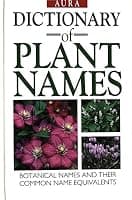
Wonderfully useful and complete, this little book includes common name cross-references, geographical distribution, and name origins, all at a bargain price. Pronunciations given are decidedly Britannic, but this seems a trivial matter in a book that fills so essential a need so conveniently.
This is a book literally of names. I’m trying to identify plants. The front cover has plants all ove
By Renee Walker, March 23, 2026
Verified Purchase
This book is definitely not useful for what I needed it for if somebody wants to buy it from me, please let me know
0
★★★★☆
Useful guide for beginners
By Thriftbooks.com User, November 7, 2007
This book is a dictionary of common, especially those found in Europe. Common and Latin names are intermixed and cross-referenced in the entries. Pronunciation guides are provided for Latin names, and the meanings of the Latin names are also explained, noting for instance, who a plant is named after, or what part of the plant the Latin descriptive term refers to. A brief glossary of plant-related terms is also provided at the beginning of the book. This is a useful, brief guide for plant enthusiasts who want to learn the Latin names for the plants they work with. Originally written for European readers, its coverage of North American plants is not always complete. Nevertheless, it may prove adequate for general users throughout the English-speaking world.
4
★★★★★
What Is the Origin of that Plant's Name?
By Thriftbooks.com User, March 11, 2000
Have you ever been curious about the origin of a plant's botanical name? How and why it got the name and what on earth it has to do with the plant? That's the type of information contained in this easy-to-use guide to botanical plant names.It lists the generic and common names in alphabetical order. The name of each plant genus is given, followed by the suggested pronunciation, the family in which it was placed and the derivation of the name.For instance, 'rana' means frog in Latin (L), and the name ran unculus is the name given to a plant, which, in many cases, prefers wet places ... like frogs. Now do you think that you will forever more connect frogs with ranunculus? If the scientific name makes sense to you or makes an association for you, it may lock into your memory. By the way, the term, 'scientific name' is preferable to 'Latin (L.) name, since many plants derive from the Greek (Gk.) or are personal names. Here are some origins of names that caught my interest, of the over 1,000 plants listed:CYMBIDIUM - from Greek 'kymbe' (a boat), referring to the hollowed lip. Greenhouse orchids. STOKESIA - was named after a person, Dr. Jonathan Stokes from Scotland. LAVANDULA - from L.'lavo' to wash, from it's use in soaps. Lavender. NICOTIANA - after Jean Nicot, (1530-1600), who introduced the tobacco plant to France. PRIMULA- from L. primus (first), referring to the early flowers of spring. Primrose.