


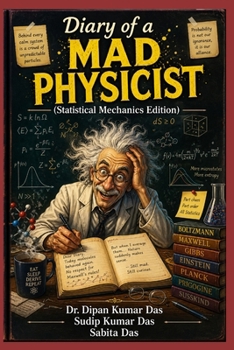
Diary of a Mad Physicist (Statistical Mechanics Edition)

Chapter 1. Dear Diary, Today I Learned That Atoms Have No Discipline
Dr. Dipan introduces the central nightmare of statistical mechanics: trillions of invisible particles behaving like unsupervised kindergarten children.
Topics:
Why classical mechanics failed to track every particle
Need for probability
Difference between certainty and "educated panic"
Why physicists started averaging their ignorance
Chapter 2. Ludwig Boltzmann and the Great Entropy TragedyThis chapter presents Boltzmann as:
the exhausted accountant of molecular disorder,
the first man brave enough to say "mess has mathematics."
Funny angles:
Entropy as room cleanliness after cousins visit
Boltzmann staring at gas molecules like a school principal who gave up
Society not understanding him because he was speaking fluent probability while others still spoke rigid mechanics
Scientific content: Father of statistical mechanics, Entropy as counting possible arrangements, Kinetic gas theory, Microscopic origin of macroscopic behavior
Chapter 3. James Clerk Maxwell and the Speeding Molecule Traffic PoliceDr. Dipan explains Maxwell as the first physicist who realized:
all molecules in a gas are not equally energetic; some are lazy, some are hyperactive, some are simply unemployed.
Funny devices:
Maxwell running a traffic survey on invisible motorcycles
Molecular speed distribution compared with students entering an exam hall
Collisions as gossip exchanges
Scientific contribution: Statistical distribution of velocities, Equilibrium by repeated collisions, Birth of probabilistic physics
Chapter 4. Josiah Willard Gibbs Builds the Statistical Mechanics Apartment ComplexFunny narrative:
Gibbs as the silent librarian of thermodynamic confusion
Inventing categories of systems like a landlord assigning flats to molecules
Ensemble theory explained as "parallel universes for physicists who cannot decide"
Chapter 5. Paul Ehrenfest and the Custodian of Boltzmann's Haunted MansionEhrenfest appears as: the intellectual heir who inherited Boltzmann's unfinished laundry basket of confusion.
Chapter 6. Albert Einstein Watches Pollen Dance and Declares VictoryDr. Dipan narrates Einstein as: the detective who watched random floating dust and said, "Aha, atoms are drunk."
Chapter 7. Max Planck and the Blackbody Oven That Burned Classical PhysicsPlanck enters as: a conservative physicist who reluctantly used statistics and accidentally opened quantum hell.
Chapter 8. Lord Rayleigh and the Molecular Whisper CampaignThis chapter shows Rayleigh as:
the gentleman scientist peeking into scattering, fluctuations, and molecular randomness.
Lewis becomes:
the chemist who politely stole ideas from statistical mechanics and used them to explain why chemicals behave less romantically than students expect.
Prigogine storms in and says:
"Why are all of you obsessed with equilibrium? Real life is unstable."
Susskind appears as:
the modern rebel who drags statistical mechanics into black holes, quantum information, and string theory.
Chapter 13. Confessions of a Mad Physicist: Why Statistical Mechanics Feels Like Guessing Correctly with Confidence
Epilogue: The Universe Is Not Determined, It Is Merely Well Averag...
Customer Reviews
ThriftBooks ® and the ThriftBooks ® logo are registered trademarks of Thrift Books Global, LLC
