


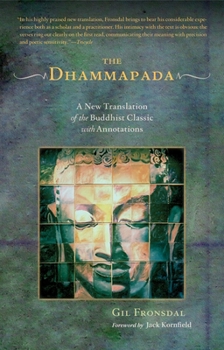
The Dhammapada: A New Translation of the Buddhist Classic with Annotations


Select Format
Select Condition 
Book Overview
A Buddhist scholar and Insight Meditation teacher presents the most universally beloved scriptures of Buddhism in this "clear, concise, and inspiring" translation that "brings these timeless passages of the Buddha right into our hearts" (Joseph Goldstein) The Dhammapada is the most widely read Buddhist scripture in existence, enjoyed by both Buddhists and non-Buddhists. This classic text of teaching verses from the earliest period of Buddhism in India conveys the philosophical and practical foundations of the Buddhist tradition. The text presents two distinct goals for leading a spiritual life: the first is attaining happiness in this life (or in future lives); the second goal is the achievement of spiritual liberation, freedom, absolute peace. Many of the key themes of the verses are presented in dichotomies or pairs, for example, grief and suffering versus joy; developing the mind instead of being negligent about one's mental attitude and conduct; virtuous action versus misconduct; and being truthful versus being deceitful. The purpose of these contrasts is, very simply, to describe the difference between what leads to desirable outcomes and what does not. For centuries, this text has been studied in its original Pali, the canonical language of Buddhism in Southeast Asia. This fresh new translation from Insight Mediation teacher and Pail translator Gil Fronsdal is both highly readable and scholarly authoritative. With extensive explanatory notes, this edition combines a rigorous attention to detail in bringing forth the original text with the translator's personal knowledge of the Buddhist path. It is the first truly accurate and highly readable translation of this text to be published in English.
Format:Paperback
Language:English
ISBN:1590303806
ISBN13:9781590303801
Release Date:December 2006
Publisher:Shambhala
Length:192 Pages
Weight:0.51 lbs.
Dimensions:0.6" x 4.9" x 7.6"
Customer Reviews
6 ratings
Beautiful
Published by Southern Summer , 3 years ago
Such a beautiful book. Wisdom is beauty and there is so much wisdom here. If you are looking for peace, direction, and a path to comfort you will find it in this book. It is where I always go to find wisdom and it never fails me. A beautiful way to live.
A poetic triumph
Published by Thriftbooks.com User , 17 years ago
I personally own ten English versions of the Dhammapada. Juan Mascaro's translation is the most beautiful and poetic I have read. The last chapter in particular (ch. 26 "The Brahmin") is a poetic masterpiece, highly evocative of the sacred. I disagree with other reviewers who believe Mascaro's translation is not accurate. Although I do not read Pali, I have studied the transliterated Pali and believe that Mascaro's translation is accurate enough. He takes minor poetic liberties, staying close to the original meaning of the text. (For scholarly study you may wish to supplement this version with a more literal translation such as that of Irving Babbitt.) This is an elegant translation of one of the world's greatest scriptures.
Beautiful
Published by Thriftbooks.com User , 18 years ago
If you are someone new, like me, to studying the Eastern philosophies this little book is just lovely. It puts things easily and simply. I enjoy reading this for inspiration and deeper understanding. I found the Introduction helpful in explainging briefly the means behind the intent and how each section is set up. It's size also makes it a lovely little book to tuck into my work bag without adding bulk or weight.
A Must Read
Published by Thriftbooks.com User , 19 years ago
I've read about 100 buddhism books, and so far, I think this one (this translation of the Dhammapada) and the Dalai Lama's "A Flash of Lightning in the Dark of Night - A Guide to the Bodhisattva's Way of Life" are the best buddhism teachings I've read to date. I read the earlier reviews by some stating this translation is not accurate. Maybe other translations are more literally word for word correct with the original; however, I feel that this translation conveys the teaching the best. Read the various translations that Riku Simonen presented in his post, and the one that Thomas gave in the comment to Simonen's post. Forget about the accuracy of the translation, which one makes the most sense? Supposively Buddha stated that a person should not follow any teaching based on blind faith, that all teachings should be questioned, and only the ones that are true to a person's heart should be followed.
Beautiful and inspiring
Published by Thriftbooks.com User , 23 years ago
The Dhammapada is one of the world's great religious classics, and its pithy, poetic style makes it very direct and inspiring. Like some of the other reviewers, I don't read Pali, and it's probably true that this isn't the most literal translation. However, I've read several translations of the Dhammapada and this has been my favorite for a long time. In any translation of a poetic nature, the translator must choose a certain balance between a strictly literal translation of the source material and a poetic rendering of the material in the target language, and Mascaro leans a little toward the latter. I've been a student of Buddhism for some years, though, and I find very few places where Mascaro's translation seems to be inaccurate --- even though there are other translations that may be a little more precise and literal. In any case, there are many Buddhist philosophical works where precision of terminology is critical, but, since the Dhammapada is a more general work consisting mainly of aphorisms, it's one work where a little poetic license seems acceptable.
This is the one I carry with me everywhere
Published by Thriftbooks.com User , 27 years ago
These basic and sacred Buddhist teachings will take you far, very far if you just read slowly. Read it when you are sad, lonely, when you are anxious, bored, or annoyed. It will calm you and it will center you, and take you back to your perfect self.
Copyright © 2026 Thriftbooks.com
Terms of Use | Privacy Policy | Do Not Sell/Share My Personal Information | Cookie Policy | Cookie Preferences | Accessibility Statement
ThriftBooks ® and the ThriftBooks ® logo are registered trademarks of Thrift Books Global, LLC
ThriftBooks ® and the ThriftBooks ® logo are registered trademarks of Thrift Books Global, LLC
