


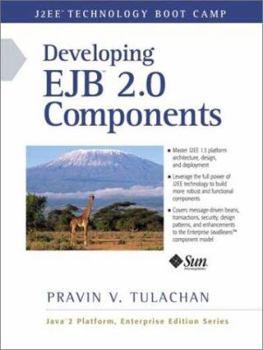
Developing EJB 2.0 Components


Aimed at Java programmers, this practical, hands-on tutorial shows how to understand, develop, and deploy Enterprise Java Beans 2.0 applications within the context of the Java 2 Enterprise Edition 1.3... This description may be from another edition of this product.
Format:Paperback
Language:English
ISBN:0130348635
ISBN13:9780130348630
Release Date:March 2002
Publisher:Prentice Hall PTR
Length:656 Pages
Weight:0.21 lbs.
Dimensions:1.1" x 7.0" x 9.3"
Customer Reviews
3 ratings
As a EJB newbie, I found this book very helpful...
Published by Thriftbooks.com User , 23 years ago
As a recently unemployed Java developer, I was at a local Borders looking at EJB books to update my skill. I picked several EJB books and then sat down with a coffee to find a easy to understand and a practical book. In my opinion the EJBs are too complicated and I was looking for hands-on book with step-by-step guide and this book was it. I was able to understand and start writing stateless session bean within few hours. I liked the fact Mr. Tulachan used Sun's J2EE Reference Implmentation, which is free, small and easy to use unlike commercial application servers that take over 150MB of disk space and require atleast 256MB -a bit complicated and difficult to use for a beginner like me. The only negative from my perspective are the typos so be sure to download the errata. As a beginner I found the step-by-step approach to EJB development very helpful and I hope it will also help me get a job as an EJB developer soon.... --raj
A very good book but you need to have some background
Published by Thriftbooks.com User , 24 years ago
This is a very good book in that it explains everything in step by step manner. In the very beginning, the author mentions the background you need to have to be able to use this book and author means it. The reason this book lost a star is the explanation of the concepts in initial chapters. If you have absolutely no background in EJB, JNDI and RMI, you might have hard time understanding the concepts. The best feature of this book is that it explains (1) the concept, (2) how to write code and (3) how to deploy the code and test it. There are very few books that does all three (most of the time other books will say deployment depends on your application server). Another good feature is that this book uses J2EE RI. Many books use servers like websphere or weblogic, which requirs hi-fi hardware and of course availability of server.If you know what EJB is and ready to start writing code, go ahead and buy the book. Be sure to keep another reference (a good online article or Ed Roman's free EJB book) to read initial concepts and be sure to download code for this book (as this books saves space by NOT providing full code)
Very helpful hands-on guide to new EJB developer.
Published by Thriftbooks.com User , 24 years ago
As a Java programmer new to EJBs, I found this book very helpful in learning the EJB 2.0. First, on the upside. I really liked the layout and the flow of the book and the complete step-by-step guide including the deployment steps with plenty of screen-shots were very useful in learning new and complicated concepts in EJBs. I also liked the fact that the author used the Sun's Free J2SDKEE 1.3 server since the disk and memory requirements are very resonable and the installation so easy that it makes starting the learning process a bit easier. Compared to commercial application servers that take 100MB and requre 512MB of RAM and not easy to install. I also like the way he deals with discrete EJBs, one at a time and then at the end puts them together as one application. I also liked the author's approach with starting slow and easy with introduction to J2EE and overview of EJB and the chapter on transaction and security in the advanced section of the book.On the down side, the author at times is verbose. Even though the author discusses the code section in the chapters using code snippet, I wish he had listed the entire soruce code in each chapter or provided the complete listing of the source code at the end of the chapter or included a CD with the source code. But in all fairness, you can download the source code and installation instruction from the compaanion web site...I would have also liked to see step-by-step deployment instruction for Weblogic and Websphere application server.BTW, being from the Bay area, I liked the author's sense of homour especially references he makes to the dot com boom just a few years ago.In summary: So if you're new to EJB development and you prefer step-by-step guide on the development and deployment of stateless and stateful session bean, bean-managed and container-managed entity beans and message-driven beans then I am sure you, too will find this book very helpful as I have. --dan
Copyright © 2026 Thriftbooks.com
Terms of Use | Privacy Policy | Do Not Sell/Share My Personal Information | Cookie Notice | Cookie Preferences | Accessibility Statement
ThriftBooks ® and the ThriftBooks ® logo are registered trademarks of Thrift Books Global, LLC
ThriftBooks ® and the ThriftBooks ® logo are registered trademarks of Thrift Books Global, LLC
