


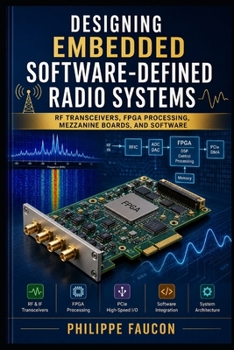
Designing Embedded Software-Defined Radio Systems: RF Transceivers, FPGA Processing, Mezzanine Boards, and Software (Aerospace Interface Standards Series)

Software-defined radio becomes much harder when it leaves the laboratory.
A bench-top SDR can rely on generous power, cooling, external cables, and hands-on operation. An embedded SDR must fit inside another system, share its power and thermal environment, move high-rate I/Q data reliably, survive startup and fault conditions, and behave like a dependable subsystem rather than a laboratory instrument.
Designing Embedded Software-Defined Radio Systems is a practical engineering guide to making that transition.
The book follows the complete signal and data path:
Antenna → RF front end → RFIC → FPGA → PCIe → driver → application
It explains the engineering decisions that determine whether a compact SDR works as a complete deployable system, including RF architecture, RFIC selection, FPGA processing, PCIe and DMA, clocking, power integrity, thermal design, signal integrity, EMI/EMC, Linux drivers, Industrial I/O, SDR frameworks, testing, and system integration.
Particular attention is given to mezzanine SDR architectures, where RF, FPGA processing, clocks, regulators, high-speed interfaces, and software must coexist inside severe size, power, and thermal constraints.
The book also examines real applications including signal intelligence, test and measurement, distributed SDR systems, industrial wireless, and IoT. Rather than presenting one reference design as the answer, it focuses on the tradeoffs, failure modes, and architectural choices engineers encounter when turning an SDR prototype into a product.
For RF engineers, FPGA developers, embedded-software engineers, and system architects who need an SDR that works outside the lab.
Customer Reviews
ThriftBooks ® and the ThriftBooks ® logo are registered trademarks of Thrift Books Global, LLC
