


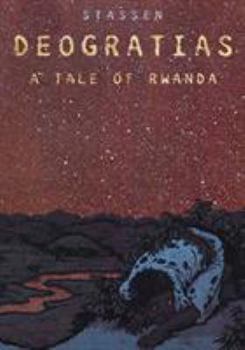
Deogratias, a Tale of Rwanda


Select Format
Select Condition 
Book Overview
The 2000 winner of the Goscinny Prize for outstanding graphic novel script, this is the harrowing tale of the Tutsi genocide in Rwanda, as seen through the eyes of a boy named Deogratias. He is an ordinary teenager, in love with a girl named B nigne, but Deogratias is a Hutu and B nigne is a Tutsi who dies in the genocide, and Deogratias himself plays a part in her death. As the story circles around but never depicts the terror and brutality of an entire country descending into violence, we watch Deogratias in his pursuit of B nigne, and we see his grief and descent into madness following her death, as he comes to believe he is a dog. Told with great artistry and intelligence, this book offers a window into a dark chapter of recent human history and exposes the West's role in the tragedy. Stassen's interweaving of the aftermath of the genocide and the events leading up to it heightens the impact of the horror, giving powerful expression to the unspeakable, indescribable experience of ordinary Hutus caught up in the violence. Difficult, beautiful, honest, and heartbreaking, this is a major work by a masterful artist.
Format:Paperback
Language:English
ISBN:1596431032
ISBN13:9781596431034
Release Date:May 2006
Publisher:First Second
Length:79 Pages
Weight:0.77 lbs.
Dimensions:0.3" x 6.1" x 8.5"
Age Range:14 to 18 years
Grade Range:Grade 9 to Postsecondary
Customer Reviews
3 ratings
The Horror
Published by Thriftbooks.com User , 19 years ago
Originally published in Stassen's native Belgium in 2000, this graphic novel takes on the 1994 Rwandan genocide and does a credible job of bringing the horror of that dark stain on recent history to the page. Alternating between the time of the genocide and a time about five years after it, the story follows a young Hutu teenager named Deogratias. Prior to the massacre, we see he is a normal boy trying to get into the pants of two pretty Tutsi sisters. However, in the aftermath of the genocide, he has been reduced to a homeless, ragtag lunatic with only moments of lucidity, who tries to keep horrible memories at bay with the aid of the local banana beer (urwagwa). Those familiar with the kinds of atrocities perpetrated in genocides or civil wars won't be particularly surprised at the final revelation as to what rendered him insane -- nonetheless, it's grim and powerful stuff. There's also a subplot involving a French tourist who served in the French army in Rwanda during the genocide. This exists mainly to highlight the French complicity in allowing the genocide to unfold -- albeit guilt that is only marginally greater than that of other Western powers. What happened in Rwanda serves to point out the emptiness of slogans such as "Never Forget", and while it has been covered by many excellent non-fiction books and films, Stassen is to be commended for bringing the horrific story to another medium. This is rough material, definitely not for kids, although the translator's introduction does a nice job of providing enough background for one to use it in a high school history or ethics class.
A STORY THAT WILL HAUNT THE READER
Published by Thriftbooks.com User , 19 years ago
Over the years when I've had to defend the medium of comics to my less illuminated friends and co-workers I've been able to point to many examples of works that rise above the mire of the usual. Things like "The Watchmen", "Bone", "Love and Rockets" and others. I will now add "Deogratias" to this distinguished group. The book is the product of Belgium writer/artist J.P. Stassen. The book is told against the backdrop of the brutal ethnic cleansing that took place in Rwanda in the early 90's as the majority Hutu savagely butchered some 800,000 of the minority Tutsi ethnic group as the world looked on and did nothing. Stassen first provides a brief, but very necessary history lesson about the events that led up the genocide and what has happened after. Stassen now resides in Rwanda with his family. The book if required reading if only for Stassen's opening monologue and history lesson. The story itself moves back and forth in time with the lead title character Deogratias. These shifts in time come with no warning or captions and at first are a little dizzying but you'll soon have it figured out. Deogratias in present time is a pathetic creature, wearing ratty clothing, and addicted to Urwagwa or banana beer. He also seems to be quite mad as other villagers ask him if he is "still a dog?" This will become significant later in the story. We first seem him interacting with a French tourist who was in the military back during the genocide. This character is meant as a representative of the French government who if they didn't actually back the horrors that took place, they turned their back as they went on. As we move back in time we learn about the past of Deogratias, a Hutu, and others of his village. We see him in school as even the teachers spew hate against the Tutsi. Deogratias is in love with A Tutsi girl named Benina but her mother wants Benina to have nothing to do with him. The radio broadcasts are filled with hateful tirades against the Tutsi who they refer to as cockroaches. Deogratias is expected to take up arms with his Hutu brothers but all he can do is think of saving Benina and her family. Ultimately he will pay for this with his very sanity. Deogratias is a powerful, tragic, horrifying story. Made all that much more terrible because of the real-life events and even worse by the world's complete lack of action to stop the violence. Was it because this was black on black racism? Was it because there were no strategic locations or oil fields as stake? Whatever the case, This is a story that will haunt the reader for a long time. Reviewed by Tim Janson
Not an easy read, but an important one!
Published by Thriftbooks.com User , 19 years ago
First published in Belgium in 2000, this translation of Deogratius: A Tale of Rwanda by Alexis Siegel may appear to be like a comic--but it does not have any humorous content. The setting is 1994 in Rwanda, in Eastern Africa. A bit of history is required. Everyone carried ID cards to designate whether they were Hutu, the majority ethnic group, or Tutsi. Extremists from the Hutu group planned to exterminate the Tutsi minority and kill moderate Hutu who opposed their goal. The ID cards made it easy for the murderers to know who to kill. The story, told through flashbacks of the days before and after the horrific genocide, is told from the viewpoint of Deogratius, a Hutu boy and Benina, a Tutsi girl. In the genocide, 800,000 humans are murdered while the world did nothing. The United Nations estimated that 3 million people were murdered as the war spilled over in the neighboring countries to find the refugees from Rwanda. The graphic author's storytelling is powerful and eloquent. The history lesson is told from the eye of a young boy and an older man--both native and white immigrants, soldiers and others. Armchair Interviews says: Not an easy read, Deogratias: A Tale of Rwanda is an important history lesson told in this manner by the author who now resides in Rwanda with his family.
Copyright © 2026 Thriftbooks.com Terms of Use
| Privacy Policy | Do Not
Sell/Share My Personal Information | Cookie Policy | Cookie Preferences | Accessibility Statement
ThriftBooks® and the ThriftBooks® logo are registered trademarks of Thrift Books Global, LLC
ThriftBooks® and the ThriftBooks® logo are registered trademarks of Thrift Books Global, LLC
