


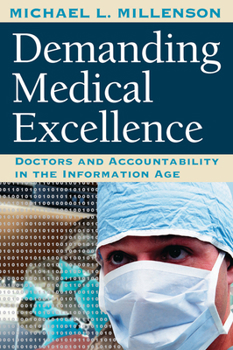
Demanding Medical Excellence: Doctors and Accountability in the Information Age

Demanding Medical Excellence is a groundbreaking and accessible work that reveals how the information revolution is changing the way doctors make decisions. Michael Millenson, a three-time Pulitzer Prize nominee as a health-care reporter for the Chicago Tribune, illustrates serious flaws in contemporary medical practice and shows ways to improve care and save tens of thousands of lives. "If you read only one book this year, read Demanding Medical Excellence. It's that good, and the revolution it describes is that important."--Health Affairs "Millenson has done yeoman's work in amassing and understanding that avalanche of data that lies beneath most of the managed-care headlines. . . . What he finds is both important and well-explained: inconsistency, overlap, and inattention to quality measures in medical treatment cost more and are more dangerous than most cost-cutting measures. . . . [This book] elevates the healthcare debate to a new level and deserves a wide readership."--Library Journal "An involving, human narrative explaining how we got to where we are today and what lies ahead."--Mark Taylor, Philadelphia Inquirer "Read this book. It will entertain you, challenge, and strengthen you in your quest for better accountability in health care."--Alex R. Rodriguez, M.D., American Journal of Medical Quality "Finally, a health-care book that doesn't wring its hands over the decline of medicine at the hands of money-grubbing corporations. . . . This is a readable account of what Millenson calls a 'quiet revolution' in health care, and his optimism makes for a refreshing change."--Publishers Weekly "With meticulous detail, historical accuracy, and an uncommon understanding of the clinical field, Millenson documents our struggle to reach accountability."--Saty Satya-Murti, M.D., Journal of the American Medical Association
Format:Paperback
Language:English
ISBN:0226525880
ISBN13:9780226525884
Release Date:February 2000
Publisher:University of Chicago Press
Length:469 Pages
Weight:1.40 lbs.
Dimensions:1.0" x 6.0" x 9.0"
Customer Reviews
5 ratings
This book could save your life ...
Published by Thriftbooks.com User , 26 years ago
The National Academy Institute of Medicine reports in their new book "To Err is Human":"Two large studies, one conducted in Colorado and Utah and the other in New York, found that adverse events occurred in 2.9 and 3.7 percent of hospitalizations, respectively. In Colorado and Utah hospitals, 8.8 percent of adverse events led to death, as compared with 13.6 percent in New York hospitals. In both of these studies, over half of these adverse events resulted from medical errors and could have been prevented. When extrapolated to the over 33.6 million admissions to U.S. hospitals in 1997, the results of the study in Colorado and Utah imply that at least 44,000 Americans die each year as a result of medical errors. The results of the New York Study suggest the number may be as high as 98,000. Even when using the lower estimate, deaths due to medical errors exceed the number attributable to the 8th leading cause of death. More people die in a given year as a result of medical errors than from motor vehicle accidents (43,458), breast cancer (42,297), or AIDS (16,516)."These are only confirmed and documented hospital deaths induced by error (wrong medication, wrong operation, failure to deal with documented symptomology, etc.) For example, Millenson points out one study that showed in a single hospital there were 51000 errors in a year and only 36 reported. There are at least 180,000 deaths and over a million injuries caused by medical error every year in the U.S. Many professionals (including the reviewer who was funded by NIH for eight years to do risk analysis in healthcare) believe that these numbers are severely undereported and that medical error is the third leading cause of death after heart disease and cancer.This book is the best available overview on the topic. If you value your life you will read it. The patient must take responsibility for monitoring treatment. If the patient is unable, family or friends must closely monitor it. Every time I give a talk on this subject someone in the audience has a personal horror story to share. Last month it was the son of the Chair of a conference I was attending whose child had a brain tumor and was in surgery the week before my talk. After surgery, the nurse was about to overdose the kid on morphine. A family member had been sleeping with the child in the hospital and logging every medication in a notebook. When they showed the log to the nurse and prevented her from administering the drug, she was shocked.These stories are not isolated events. If airlines were like hospitals, every time 200 people disembarked from a flight, 7 passengers would be injured or dead.The most tragic part of this story is that if healthcare institutions where automated like most industries, over 50% of these errors would disappear the first day they turned on the computers.
Knowledge plus accountability equals better patient care
Published by Thriftbooks.com User , 26 years ago
Experts estimate that over one hundred thousand patients die each year as a result of medical malpractice. Why does this continue to happen in a country as sophisticated as ours, and what can we do to stop it? In "Demanding Medical Excellence", Michael Millenson, a three-time Pulitzer Prize nominee and former reporter for the Chicago Tribune, believes that he has found a few solutions to this overwhelming problem. "The keys to medical excellence," Millenson writes, "are information and accountability." Millenson, who was thrust into the middle of this country's health care crisis, while researching patient's horror stories, examines our health care system from every angle. He believes that the breakdown in this country's health care system can be traced to two things - the sudden plethora of medical information and technology, and the failure of the health care system to distill this knowledge to its physicians in a way that is understandable and useable. In other words, the knowledge may be there, but is it really helping American patients get well and stay healthy? From his research, the answer is no. In his book, Millenson makes a strong case for making our health care system as quality-minded as other previously antiquated industries. He tests his theories by examining health care systems that have redesigned themselves into well-oiled machines that would make Deming proud. For example, Salt Lake City's LDS Hospital. LDS has designed a technologically-advanced computer system, that gives physicians the data they need to treat a patient right at the bedside, enhancing the physician's knowledge, with data culled from the treatment of thousands of patients with the same illness. The results were startling, in some cases, improving patient care and mortality by forty or fifty percent.Although many HMOs are trying to reinvent themselves, Millenson doubts that managed care or nominal exercises in quality assurance, will be the answer to our health care problems. He believes that by harnessing technology, the health care industry can give physicians the knowledge they need, to treat patients with the best result in mind. Millenson is quick to add that, after knowledge, comes physician accountability. In the end, it is only by holding physicians and hospitals accountable for their treatment decisions, that the patient will ultimately win.
Excellent analysis and a delight to read!
Published by Thriftbooks.com User , 28 years ago
"Demanding Medical Excellence" is a thoughtful, well-researched, credible illumination of both the stumbling blocks to providing efficient, quality health care and the opportunities afforded by new information technologies. I am an experienced health care professional and am very involved in efforts to influence health policy and health services delivery. "Demanding Medical Excellence" added depth to my understanding of the issues of accountability in medicine and information as a currency of power. I highly recommend this book to anyone interested in understanding the facts and implications of current efforts to change the way health care is delivered. It is engaging, informed and important.
Great review of medicine's struggle for accountability
Published by Thriftbooks.com User , 28 years ago
This is a tremendously readable study of a very dry subject. While meticulously documented, Millenson's style is so entertaining that this book makes for good vacation reading for anyone involved in the health care industry. I am one one of those company benefit managers described at the start of Chapter 10, caught between employees unhappy with managed care rules and a management intent on holding the line on costs. This book gives me hope. With time and the right incentives, managed care can be the framework in which quality management in health care becomes visible to consumers. Congress and the medical profession ought to focus on making it happen.
Excellent survey of medical practice in the US
Published by Thriftbooks.com User , 28 years ago
Well written survey of how the practice of medicine is just like other professions--it's difficult to propogate best practices, human beings tend to do the same things over and over without understanding whethe they are effective, and health care providers are complex systems. Uses anecdotes, statistics, successes and failures to illustrate how far we've come and how far we've yet to go to provide state of the art medical care in the US.
Copyright © 2026 Thriftbooks.com
Terms of Use | Privacy Policy | Do Not Sell/Share My Personal Information | Cookie Policy | Cookie Preferences | Accessibility Statement
ThriftBooks ® and the ThriftBooks ® logo are registered trademarks of Thrift Books Global, LLC
ThriftBooks ® and the ThriftBooks ® logo are registered trademarks of Thrift Books Global, LLC
