


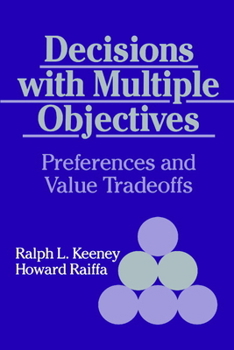
Decisions with Multiple Objectives: Preferences and Value Trade-Offs


Select Format
Select Condition 
Book Overview
Many of the complex problems faced by decision makers involve multiple conflicting objectives. This book describes how a confused decision maker, who wishes to make a reasonable and responsible choice among alternatives, can systematically probe his true feelings in order to make those critically important, vexing trade-offs between incommensurable objectives. The theory is illustrated by many real concrete examples taken from a host of disciplinary settings. The standard approach in decision theory or decision analysis specifies a simplified single objective like monetary return to maximise. By generalising from the single objective case to the multiple objective case, this book considerably widens the range of applicability of decision analysis.
Format:Paperback
Language:English
ISBN:0521438837
ISBN13:9780521438834
Release Date:July 1993
Publisher:Cambridge University Press
Length:592 Pages
Weight:1.75 lbs.
Dimensions:1.4" x 6.0" x 9.1"
Customer Reviews
2 ratings
Excellent utility and decision theory foundation
Published by Thriftbooks.com User , 19 years ago
This book is a very good foundation of MCDA (Multi Criteria Decision Analysis) with all the mathematical proofs behind the theory. The authors give real life examples on the application of their model and explain the intuition of their methodology. Although the math is a bit advanced, the authors explain step-by-step all the terminology, what makes the theory easily understandable. I have used it as a reference in a course of my M.Sc. in Operations Research and Decisions, but I believe undergraduates can understand it (not without sweating a few drops). Personally, I believe that Keeney's book "Value Focused thinking" is more intuitive and day-to-day oriented, but the bulk of the theory is presented in this earlier book. So if you like math and economics, you should try this book first.
Methodology on preference retrieval implementation
Published by Thriftbooks.com User , 26 years ago
This is a very good book grounded in solid microeconomic theory foundations. It starts with classical micro theory such as preferences and axioms, and it moves on to risky preferences and methods on how to retrieve them by constructing careful experiments. It also discusses the limitations on preference retrieval by such axiomatic methods due to the heuristics and biases that occur in decision making behaviour. However, this book is also useful for non-economists, as it describes decision making theories and applied methods on how to retrieve preferences in fields such as policy and medical sciences. The book's target market is mostly economics/ decision sciences graduate students or those who have achieved a comparable or higher level of their studies/work experience. It has also very instructive real world examples of PhD students running preference retrieval experiments and reporting their results. Good book for those keen on the subject. The 1976 version of the book has won a book prize, hence the assurance of quality. Furthermore, Raiffa is a well established Harvard academic, which further lends credence to the book.
Copyright © 2026 Thriftbooks.com
Terms of Use | Privacy Policy | Do Not Sell/Share My Personal Information | Cookie Policy | Cookie Preferences | Accessibility Statement
ThriftBooks ® and the ThriftBooks ® logo are registered trademarks of Thrift Books Global, LLC
ThriftBooks ® and the ThriftBooks ® logo are registered trademarks of Thrift Books Global, LLC
