Skip to content
ISBN: 1144961726
ISBN13: 9781144961723

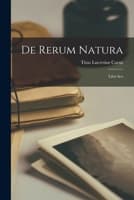
De Rerum Natura Libri Sex; Volume 1

$32.95List Price: $32.95
ISBN: 1144961726
ISBN13: 9781144961723
Formats

Conditions

A brand-new, unused copy in perfect condition.

Formats

Conditions

A brand-new, unused copy in perfect condition.

See all 55 editionsfrom $32.95

Book Overview

With its extensive annotation and vocabulary, this book is designed to provide all the help required by the comparative beginner in Latin who is coming to Lucretius for the first time. At the same time the Introduction and Commentary are full enough to incorporate material of interest to the Lucretian specialist, and elucidates both the poetic artistry and philosophical content.

The first book of Lucretius claims attention not only on the strength of the famous introduction to the whole poem but because its treatment of atoms and void provides the fundamental basis on which the remaining books depend. Lucretius offers his readers a complete guide to happiness and a total tour of the universe. Even a few selections from his poetry reveal the radical freethinker at his very best.

Drawing on the latest research into the text and interpretation of Lucretius, this book is aimed at the sixth-former or undergraduate who seeks a helpful introduction to the poem; and very little background knowledge of Latin literature is assumed.

This description may be from another edition of this product.
Format:
Paperback
Language:
English
ISBN:
1144961726
ISBN13:
9781144961723
Release Date:
February 2010
Publisher:
Creative Media Partners, LLC
Length:
706 Pages
Weight:
2.14 lbs.
Dimensions:
1.4″ × 6.1″ × 9.2″
Ancient & Classical LiteratureClassicsCriticism & TheoryForeign Language Study & ReferenceForeign LanguagesGreekHistoryHistory & CriticismHumanitiesInstructionLiterary Criticism & CollectionsLiteratureLiterature & FictionMedievalMovements & Periods

More by Lucretius

Customer Reviews

1 customer rating | 1 review
Write a Review

As with all Greek writings, the Translator makes a difference. Translator Hugh Andrew Johnstone Munr

Just as in the Iliad by Homer, the translation can make a significant difference in what you are reading. With “De Rerum natura” or “The Nature of Things” by Lucretius, a glaring difference is that the word “matter” can also be the word “atom,” depending on the translation. I will not go through the different translations here, but you need to be aware and probably try different translations. My favorite translation is “New Verse Translation” by Ian Johnston. It looks like the sample shown for the Kindle is this translation. If you can find it, Hugh Ross reads a good 7-CD version. Some Kindle versions have text-to-speak. Titus Lucretius Carus, born around 99 BCE, has a good handle on “The Nature of Things,” a poem written in some 7,400 dactylic hexameters, and he makes a good argument for the existence of things and how they work. He goes on to dabble in all things from celestial and terrestrial phenomena. He had to do this without knowing that the 21st century has instruments and ways to know more than our senses with accuracy and application. He would not know of the quantum world. I suspect this book was on Darwin’s bedside table.

0