
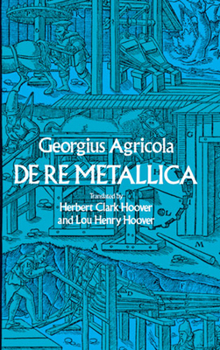
Georgius Agricola De Re Metallica is a book written in Latin by the German scholar Georg Bauer, also known as Georgius Agricola, in 1556. The book is a comprehensive study of mining and metallurgical practices during the Renaissance period. It covers a wide range of topics, including the history of mining, the geology of minerals, the methods of mining and smelting, and the use of metals in various industries.The book is divided into twelve sections, each of which covers a specific aspect of mining and metallurgy. The first section provides an overview of the history of mining, while the second section focuses on the geology of minerals. The third section discusses the methods of prospecting and exploration, while the fourth section covers the extraction of metals from ores.The fifth section of the book is dedicated to the smelting of metals, while the sixth section discusses the refining of metals. The seventh section covers the casting of metals, while the eighth section discusses the properties of metals and their use in various industries.The ninth section of the book provides a detailed description of the mining industry in Germany during the Renaissance, while the tenth section covers the mining industry in other European countries. The eleventh section discusses the mining industry in Asia, Africa, and the Americas, while the twelfth and final section provides a summary of the book.Georgius Agricola De Re Metallica is considered to be one of the most important works on mining and metallurgy ever written. It was widely read and studied during the Renaissance and continues to be an important resource for historians, geologists, and metallurgists today. This edition of the book, translated into English by Herbert Clark Hoover, provides a valuable resource for those interested in the history of mining and metallurgy.1912. Translated from the first Latin edition of 1556 with biographical introduction, annotations and appendices upon the development of mining methods, metallurgical processes, geology, mineralogy and mining law from the earliest times to the 16th century.This scarce antiquarian book is a facsimile reprint of the old original and may contain some imperfections such as library marks and notations. Because we believe this work is culturally important, we have made it available as part of our commitment for protecting, preserving, and promoting the world's literature in affordable, high quality, modern editions, that are true to their original work.
An essential book for the medievalist or art historian. Explains techniques and methods that have been lost to modern people over time.
Ian Myles Slater on: A Humanist's Industrial Handbook
Published by Thriftbooks.com User , 22 years ago
Georg Pawer was an extremely well educated German in the Humanist tradition of the late fifteenth and early sixteenth century. It was natural that he turned his Greco-German name into Greco-Latin, labeling himself Georgius Agricola. Both versions mean Farmer (Georgios) Farmer (Pawer = Bauer / Agricola). He was a physician by profession. Neither side of his background would seem to suit him to write one of the great books on mining and the refining of ores, but as an official town physician, responsible for treating miners at no additional charge, he seems to have won their trust. The result was a manual, aimed not at people who would have to dig up ores, but at potential investors, and officials and lawyers, who would have to deal with financing, administration and litigation. He set out the basic customs and practices of mining, described the remarkably elaborate machines needed to keep mines dry and ventilated, and processing and refining, with their devices and chemicals. Naturally, he wrote it in the language of real scholarship, Latin, not sixteenth-century German. Since surviving classical Latin is not abundantly supplied with appropriate technical terms, and those which exist are not always clear, the resulting text was soon found to present formidable difficulties, despite important aids from accompanying illustrations. There were early attempts at translating it into German, and even a rendering into Chinese (an early attempt to emulate the mysterious Occidentals and their terror-weapons), but when this translation appeared in 1912, German scholars were humiliated to find that they had been outclassed by a couple of mere "Englanders". They were probably even less happy to find that the translators were Americans. Actually, Lou Henry Hoover, a good classicist, made a perfect team with her husband, the mining engineer Herbert Hoover, who was shortly to become much better known for humanitarian relief work, and an unhappy experience as President of the United States. The engineering half of the partnership knew what the problems were, and the sort of thing that Agricola must have been trying to say, and the classicist could tell whether the vocabulary and grammar could carry that meaning. The result was a book which was not only beautiful, with its reproductions of the original illustrations, but a genuine contribution to the history of technology. The Dover reprinting of 1950 was one of the first, if not the first, of that publisher's adventures in bringing important works back into print, in attractive editions, at reasonable prices. It remains a gem, whether regarded from points of view of the history of technology, of art, or of Renaissance Humanism. The only thing missing is Agricola's companion treatise on other hazards of mining, like kobolds and other malicious spirits (yes, I am serious; he had lots of testimony from honest miners, after all). Of course, nothing human is perfect, and there are some hints of why such a practical
Excellent attention to detail of ancient mining practices
Published by Thriftbooks.com User , 26 years ago
This book is a great read. The sections are well defined to cover each topic, including measurements where applicable and even the definition of tracts and management of said lands. He has written other books too. I hope they reprint the translations soon.
essential reading for students of technological history
Published by Thriftbooks.com User , 26 years ago
This early work describes the thinking of early technologists and shows the development of materials technology and related engineering knowledge of the late 15th century. Of particular interest is the detailed research done by Herbert Hoover, former President and mining engieer. His research is detailed in extensive foot notes. The illustrations are exact copies of the originals. Some of the early chapters are the most intersting reading because of the insights gained into archaic thinking that extrapolates to modern times.
A superbly illustrated classic
Published by Thriftbooks.com User , 27 years ago
This is one of the great classics, richly illustrated with over 200 woodcuts, most full page. It was published in 1556 by Georgius Agricola. The English translation is by former U.S. President Herbert Hoover, and first Lady Lou. Virtually all of the equipment illustrated was current until a few decades ago. Agricola describes and illustrates such "modern" methods as amalgamation, and the use of spiral inclines for transporting heavy equipment from the surface to underground. The (unnamed) "books" (chapters) which compose the book could be titled: 1 The Social Impact of Mining; 2 Mine Management, Exploration, and Prospecting; 3 The Theory of Ore Deposits; 4 Mining Law; 5 Shaft Sinking, Drifting, and Surveying; 6 Mining Equipment, Haulage, Dewatering, Ventilation, and Hazards; 7: Assaying; 8 Beneficiation; 9 Smelting; 10 Separation of Gold from Silver and Silver Refining; 11 Separation of Gold and Silver from Copper and Iron and Copper Refining; 12 Industrial Mineral, Chemical, and Glass Production. The text is a bit dense, but is worth the trouble.
ThriftBooks sells millions of used books at the lowest everyday prices. We personally assess every book's quality and offer rare, out-of-print treasures. We deliver the joy of reading in recyclable packaging with free standard shipping on US orders over $15. ThriftBooks.com. Read more. Spend less.

