


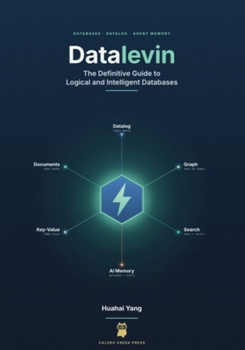
Datalevin: The Definitive Guide to Logical and Intelligent Databases

SQL has been the default language of application databases for half a century. That default is now holding application state back.
Modern applications rarely fit neatly into SQL's table-first model. A product may need transactions, graph relationships, documents, full-text search, vector similarity, and persistent AI memory in the same workflow. The usual response is to add ORM layers, side indexes, vector stores, and auxiliary services-making ordinary application data harder to model, query, and change.
Datalevin offers a different foundation. It is a compact open-source database that stores application state as durable facts and queries those facts with Datalog. Built on LMDB, it combines ACID transactions, key-value storage, relational and graph relationships, documents, full-text search, vector search, and derived knowledge in one logical database.
This guide makes replacing SQL at the center of application systems practical. It teaches Datalevin as a complete database rather than only a query language, covering its data model, transactions, schemas, identities, indexes, queries, performance, deployment, operations, and failure modes.
You will learn how to:
This guide is for engineers who build data-intensive applications and are ready to stop treating SQL as inevitable. You may be building an embedded application, a backend service, a knowledge graph, a search-heavy product, a durable workflow system, or an AI application that needs persistent memory.
Basic familiarity with transactions, indexes, schemas, and querying is helpful. No previous Datalog experience is required; the guide introduces Datalog from first principles and develops it throughout the modeling, search, performance, and intelligent-systems chapters.
Customer Reviews
ThriftBooks ® and the ThriftBooks ® logo are registered trademarks of Thrift Books Global, LLC
