


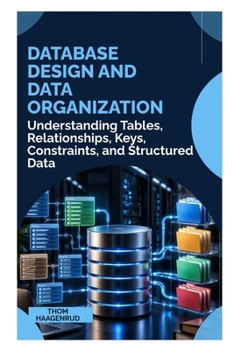
Database Design and Data Organization: Understanding Tables, Relationships, Keys, Constraints, and Structured Data

Design Better Databases. Build Stronger Data Models. Think Like a Database Engineer.
A database can store millions of rows and still be poorly designed.
Database Design and Data Organization provides a practical, step-by-step approach to designing relational databases that are clear, reliable, maintainable, and ready to evolve.
Instead of treating database design as a collection of complicated rules, this book teaches you how to reason about data: what each fact means, where it belongs, how records should be identified, how tables should relate, and which rules should be protected by the database itself.
Inside, you'll learn how to:
Turn real-world requirements into structured relational models
Design tables and columns around clear, meaningful facts
Choose appropriate data types, domains, and nullability
Understand candidate, primary, alternate, natural, surrogate, and composite keys
Model one-to-one, one-to-many, and many-to-many relationships
Use foreign keys and referential integrity correctly
Apply PRIMARY KEY, FOREIGN KEY, UNIQUE, NOT NULL, CHECK, and DEFAULT constraints
Understand NULL and SQL's three-valued logic
Identify functional dependencies and normalization problems
Work through First, Second, and Third Normal Forms
Build Entity-Relationship models and transform them into relational schemas
Follow a repeatable database design workflow from requirements to implementation
Translate logical designs into SQL without losing the underlying model
Test valid and invalid data deliberately
Troubleshoot duplicate data, broken relationships, excessive NULLs, and other schema problems
Maintain, document, evolve, and refactor databases as requirements change
You'll encounter practical scenarios involving customers, orders, products, inventory, students, courses, employees, departments, appointments, libraries, billing, and projects, making abstract concepts easier to connect to real design decisions.
The approach is intentionally portable across database platforms. The book focuses first on relational principles and design reasoning rather than tying those principles to a single vendor or database product.
Whether you're learning database design for the first time, strengthening your SQL foundation, reviewing an existing schema, or looking for a practical reference for relational modeling, this book gives you a framework for making better decisions before-and after-you write CREATE TABLE.
Stop designing databases by intuition. Start designing them by meaning, rules, relationships, and evidence.
Customer Reviews
ThriftBooks ® and the ThriftBooks ® logo are registered trademarks of Thrift Books Global, LLC
