


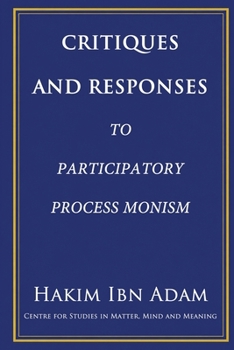
Critiques and Responses to Participatory Process Monism

One hundred philosophers, theologians, mystics, and scientists put a single metaphysical system, Participatory Process Monism (PPM), on trial in Critiques and Responses to Participatory Process Monism. PPM is a framework synthesizing classical Islamic metaphysics (Ashʿarite occasionalism, Ṣadrian process philosophy, Akbarian theophanic ontology, and Dāmādian temporal architecture) with Whiteheadian process thought and contemporary Western philosophy. Organized into nine thematic parts, the hundred critics interrogate the coherence of process metaphysics, the logic of participation, the limits of metaphysical knowledge and language, the challenge of empirical science, the demands of existentialist authenticity, the integrity of revealed theology, the rigour of dialectical method, the claims of phenomenology, and the dissolutions offered by Buddhist, Daoist, and Vedāntic non-dualism. Each part answers its critics in the form of the scholastic quaestio: the Question is posed, the Voices of the critics are heard in full force, Counter-Testimony is drawn from within the very tradition PPM inherits, a Determination concedes what must be conceded and defends what can be defended, and each objection receives its own direct reply. This book is an encyclopaedic stress test, conducted with the precision the subject demands: the verification principle and its self-refutation, the Agrippan trilemma, the Kantian transcendental boundary, Ibn Sīnā's Floating Man argument, the Chinese Room argument, the falsifiability criterion, Quine's Two Dogmas of Empiricism, the hard problem of consciousness, and dozens of comparable instruments drawn from analytic philosophy, phenomenology, Islamic kalām and falsafa, and the Buddhist and Vedāntic traditions, are deployed and answered. Readers seeking comparative metaphysics, the contemporary reception of Islamic philosophy in dialogue with Western and Eastern thought, or a model of how a philosophical system should be defended against its strongest critics, will find here a work of unusual scope and rigour: a single sustained argument tested against an entire intellectual tradition, voice by voice, and objection by objection.
Customer Reviews
ThriftBooks ® and the ThriftBooks ® logo are registered trademarks of Thrift Books Global, LLC
