


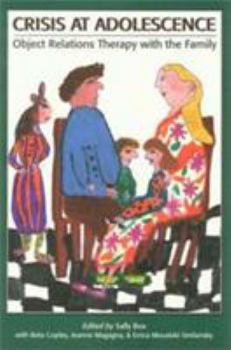
Crisis at Adolescence: Object Relations Therapy with the Family (The Library of Object Relations)


This book is about work with adolescents and their families. It is based on a particular psychoanalytic understanding of the way people function and grow and on the development of a corresponding... This description may be from another edition of this product.
Format:Hardcover
Language:English
ISBN:1568210949
ISBN13:9781568210940
Release Date:July 1977
Publisher:Jason Aronson, Inc.
Length:296 Pages
Weight:0.95 lbs.
Dimensions:9.0" x 1.1" x 6.0"
Customer Reviews
1 rating
Essential reading for those who work with Families
Published by Thriftbooks.com User , 27 years ago
For me the most important unifying feature of this book was the issue of change in families. What sort of change are we aiming for and how are we going to bring it about? These are pressing questions for social workers, and are discussed in a helpful epilogue by the editor, Sally Box. This model of family therapy, which emphasises change from within, is in stark contrast to the facile prescriptions for behavioural change found in so many child protection plans. This view is not a theoretical preference, but a practical one. British psychoanalytic concepts have lent themselves particularly well to work with families. These influences have crossed the Atlantic in the work of the Scharffs and Zinner & Shapiro. The authors of "Crisis at Adolescence" acknowledge a debt to the work of Melanie Klein and her followers, particularly Wilfred Bion, as well as those analysts who have applied these ideas to groups and institutions. Klein's concepts of an unconscious world of internal objects and projective identification are particularly helpful in understanding the dynamics of family life. When a couple come together to form a family, each brings not only their objective experience of family life, but an unconscious world which has been so beautifully described by Joan Rivière as, "..A world of figures formed on the pattern of the persons we first loved and hated in life, who also represent aspects of ourselves.." If this internal world is filled with figures who are damaged or in conflict this is a source of what may be felt to be unbearable emotional pain. One way of dealing with this is by externalising the difficulties. The mechanism by which this takes place is projective identification, an unconscious phantasy that a part of ourselves can be split off and located elsewhere. However, as Bion points out, this phantasy can have a very real effect on the recipient. In some ways this is the familiar concept of the `scapegoat', but Klein's concepts allow us to conceptualise family relationships in a more complex way, as the re-enactment of the internal conflicts and shared unconscious anxieties of the family members. In order to get in touch with these issues the psychoanalytic family therapist pays attention not only to what the family says and does, but also to their own experience of the family, their countertransference. This is described very clearly by editor Sally Box. (page 72), "The task of the therapist, then, is to be available to play a part in his patient's phantasy scenario, but rather than enacting the projections as he is implicitly invited to, it is to monitor his minute by minute experience in order to try and understand what part he is being required to play and to transform it..". The process whereby the transformation takes place can be understood in terms of Bion's concept of containment. The therapist receives the unbearable experience The therapist receives the unbearable experience and pro
Copyright © 2026 Thriftbooks.com Terms of Use
| Privacy Policy | Do Not
Sell/Share My Personal Information | Cookie Policy | Cookie Preferences | Accessibility Statement
ThriftBooks® and the ThriftBooks® logo are registered trademarks of Thrift Books Global, LLC
ThriftBooks® and the ThriftBooks® logo are registered trademarks of Thrift Books Global, LLC
