


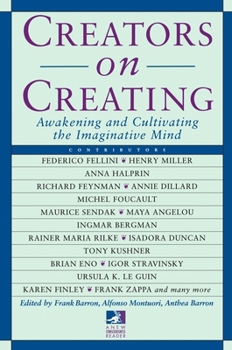
Creators on Creating: Awakening and Cultivating the Imaginative Mind


Select Format
Select Condition 
Book Overview
This collection of over three dozen essays ponders the essence of creativity. Includes selections from Henry Miller, Federico Fellini, Rainer Maria Rilke, Isadora Duncan, Frank Zappa, and Mary Shelley. A New Consciousness Reader.
Format:Paperback
Language:English
ISBN:0874778549
ISBN13:9780874778540
Release Date:April 1997
Publisher:Tarcher
Length:256 Pages
Weight:0.91 lbs.
Dimensions:1.0" x 6.0" x 9.0"
Age Range:18 years and up
Grade Range:Postsecondary and higher
Customer Reviews
4 ratings
Very inspiring and descriptive
Published by Thriftbooks.com User , 18 years ago
As a composer, I bought this specifically to figure out how to hunt down creativity and not wait for it to hit me. This book delves into the sources of creativity from many famous and successful people, and it's from the people themselves. It's a pretty easy read, and the subjects speak from such a personal origin that it seems intuitive. I'd highly recommend it if you're a writer, a musician, a film maker, an artist, anyone in the creative field.
A true treasury
Published by Thriftbooks.com User , 18 years ago
This book is a fascinating read - the selection of writings is fabously diverse and offers a myriad of views on creativity. It is easy to read and can be picked up and put down at any time with its short chapters. It is indeed a true treasure
Serendipity
Published by Thriftbooks.com User , 22 years ago
I picked up this book idly and became interested in it. The selections are good. The creative mind is both full and empty. Serendipity means coming on an unexpected treasure. Cathy Johnson explains that her father had an unshakable need to wander. Richard Feynman reports that teaching is an interruption, but that the questions of the students are often a source of new research. When Feynman felt burnt out at Cornell someone threw a plate in the cafeteria. He saw it wobble so he started to figure out the motion of a rotating plate. It was effortless. It was easy. It was like uncorking a bottle. His mind started to flow. Kary Mullis, molecular biologist, notes that important inventions almost always cross disciplines. Mullis discovered the PCR, Polymerase chain reaction. It is widely used by molecular biologists. What is necessary for creative activity may be quite destructive of other kinds of activity. Yeats thought that rhythm prolongs contemplation. Annie Dillard sees herself as an explorer and also a stalker. Italo Calvino relates that in devising a story the first thing that comes to mind is an image. In the acutal writing of the story, the words, the verbal aspect start to become more important. Imagination is a repertory of what is potential. The imagination is a kind of electronic machine. Michel Foucault suggests that utopias afford consolation although they have no real locality. Those who have creative power find the strength of mind to reject what is not true. Mabel Dodge Luhan describes an experience with peyote where she had a momentary glimpse of life given by an expansion of consciousness. Creativity lives and dies within an ecology. Maya Angelou believes that black American art is rooted in music. N. Scott Momaday feels that southwestern landscape, turning up frequently in his writing, is more spiritual. He does not see any validity in separating man from the landscape. The oral tradition of the American Indian is intrinsically poetic. The Indian has the advantage of a very rich spiritual experience. The creative process involves a tension between opposites. All the factors of creativity can be increased through training. The discipline and routine of creativity do not have to be boring. Stravinsky writes that all creation presupposes a sort of appetite. He believed that we have a duty towards music, namely to invent it. The faculty of creating is never given to us by itself.
Psychology of Creativity
Published by Thriftbooks.com User , 25 years ago
This was by far one of the greatest books that I have ever read on psychology. It was funny, touching, sweet, but most of all thought provoking. As an aspiring artist, it helped me to comprehend myself a little better. The book is a compilation of essays, interviews, and writings by different creative individuals. From the flamboyant Maya Angenlou to the brilliant Federico Fellini. Probably the most moving and amusing segment of the book was the segment written by Frank Zappa, who explains creativity in a way that no other could. Sure genius.
Copyright © 2025 Thriftbooks.com
Terms of Use | Privacy Policy | Do Not Sell/Share My Personal Information | Cookie Policy | Cookie Preferences | Accessibility Statement
ThriftBooks ® and the ThriftBooks ® logo are registered trademarks of Thrift Books Global, LLC
ThriftBooks ® and the ThriftBooks ® logo are registered trademarks of Thrift Books Global, LLC
