


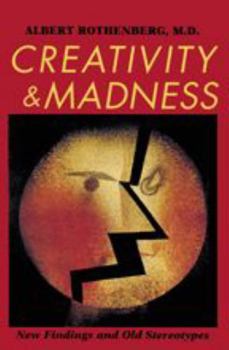
Creativity and Madness: New Findings and Old Stereotypes


Select Format
Select Condition 
Book Overview
Intrigued by history's list of "troubled geniuses,"Albert Rothenberg investigates how two such opposite conditions-outstanding creativity and psychosis-could coexist in the same individual. Rothenberg concludes that high-level creativity transcends the usual modes of logical thought-and may even superficially resemble psychosis. But he also discovers that all types of creative thinking generally occur in a rational and conscious frame of mind, not in a mystically altered or transformed state. Far from being the source-or the price-of creativity, Rothenberg discovers, psychosis and other forms of mental illness are actually hindrances to creative work. Disturbed writers and absent-minded professors make great characters in fiction, but Rothenberg has uncovered an even better story-the virtually infinite creative potential of healthy human beings.
Format:Paperback
Language:English
ISBN:0801849772
ISBN13:9780801849770
Release Date:September 1994
Publisher:Johns Hopkins University Press
Length:208 Pages
Weight:0.70 lbs.
Dimensions:0.5" x 5.8" x 9.0"
Grade Range:Postsecondary and higher
Customer Reviews
2 ratings
Interesting insights about creativity
Published by Thriftbooks.com User , 21 years ago
I found Rothenberg's insights about the characteristics of creativity the most meaningful ideas in the book. He has learned several methods of those who are creative, and these are helpful anyone wanting to be creative or help someone else like a child become creative. He does a good job debunking some of the myths that associate creativity with mental illness by showing several cases of mentally ill creators. He shows that their creative times did not coincide with the severe bouts of mental illness. He profiles a few artists, Sylvia Plath, Emily Dickinson, Eugene O'Neil, and JOhn Cheever among others. It is interesting to read how these successful people dealt effectively or ineffectively with mental illness. The author offers his conclusions about creativity and its association with mental illness. Whether they are ultimately conclusive, the reader can decide. He is a thorough researcher and writer, so this is a book worth reading if you are interested in the subject matter.
A Psychiatrist Looks at Creativity
Published by Thriftbooks.com User , 26 years ago
Rothenberg looks at creativity from the perspective of a scientist. He examines psychological ideas- Freudian, depression, bi-polar, schizophrenia; linguistic trends- use of alliteration, metaphors, rhymes; personality characteristics- motivated, determined, and able to organize one's ideas; and relates them all to his search for answers to why some can create such wonderful works of art. He dispells myths about creativity being some mystical birth-right that only the chosen few possess, and implies the conclusion that creativity is more the product of an aware mind and feeling human being than tormented genius. Good book, quick read.
Copyright © 2026 Thriftbooks.com Terms of Use
| Privacy Policy | Do Not
Sell/Share My Personal Information | Cookie Policy | Cookie Preferences | Accessibility Statement
ThriftBooks® and the ThriftBooks® logo are registered trademarks of Thrift Books Global, LLC
ThriftBooks® and the ThriftBooks® logo are registered trademarks of Thrift Books Global, LLC
