ISBN: 037576268X
ISBN13: 9780375762680
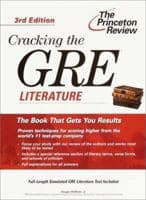
Cracking the GRE Literature Test, 4th Edition
ISBN: 037576268X
ISBN13: 9780375762680
Formats
Conditions
Formats
Conditions
This was a great resource - it's very hard to find information on the GRE Literature exam - ETS only has 1 practice test available. This guide helped me to focus my study by helping me to figure out what works/authors to spend the most time on. I made flashcards using the study guides in the back, which was also extremely helpful. The practice exam with detailed answer guide gave me one more opportunity to practice taking the test before the big day. Using the book alone isn't enough - but using the book to direct your studying is a huge help.
I found this book very helpful in my preparation for the GRE Literature Subject Test. I feel compelled to point out, in response to other reviews I've seen of this book, that it is not intended to be an all-in-one study guide. Buying this book and expecting to see a page-by-page breakdown of the GRE subject test and exactly what will be on it will only lead to disappointment. If it is used as per its intent, however, it can be invaluable. It's entirely true that the book does not cover everything that will be on the subject test. It doesn't claim to do so. What it does have is a list of material that is commonly covered, a timeline of prominent authors during various literary periods, a discussion of test-taking strategies, a full-length practice test with in-depth explanations, and the all-important glossary of literary terms and forms. I found the last most helpful and valuable. It won't teach the history of literary criticism in a day, nor will it include every poetic form or literary term, but it will provide a resource for study that I found invaluable. If you're looking for a one-stop ticket to an 800, this book isn't for you. If you're looking for a resource, however, it may be exactly what you need. Grouped with the Norton anthologies, the practice test sent by ETS to each registrant before the examination date, and knowledge gleaned from undergraduate courses, I think this book can be an excellent study tool and can take you closer to achieving a high score.
Contrary to the previous two reviewers, I did find that using the Princeton Study guide helped me in my preparation for and approach to the GRE Subject test. It is true that many of the emphasized texts did not appear on the version I took (no "Ulysses" or "Second Coming", "Elegy in a Country Churchyard" or Herrick's Julia poems), but quite a few were there, and the clues this book offered to spot such works (e.g. Pepys' diary, the distinctions between J.S. Mill and Cardinal Newman) helped me rack up more points than I otherwise would have. I will not argue with the others on the issue of modern lit: the book is much too light on 20th century stuff, which did appear substantially on my test. Princeton Review NEEDS to update this aspect of their book; however, I was prepared for such questions based on my reviewing of Norton Anthologies, a suggestion that this book stresses highly. No 20th century author who appeared on the test is absent from the Nortons.I dont know about anyone else, but the fact that the sample test in this book was more difficult than the actual test made me feel better about my performance last week. Also, my test featured a comparable amount of questions matching authors to novels and short passages to titles.I still think that a test-taker who does not utilize this book will be at a serious disadvantage when test-day comes; in addition to purchasing this book, I also recommend using Edith Hamilton's "Mythology" to solidify your knowledge of Greek/Roman stories (it helped me to retain the names of characters, which I often have a problem with when reading plot summaries), and, if your library has it, the Martin S. Day series on the history of English Literature, in three volumes. It's out of print, but a great study tools. Masterplots, if you can check them out or access them in a library, are good for Victorian mega novels and Continental Lit (Goethe, Ibsen, Mann, Balzac, Brecht, etc), though you shouldn't focus too much here. As for the 20th century stuff, focus on any Noble Prize winner, look over Nortons, and possibly through Salon.Com's Guide to Contemporary Authors, but realize that, especially with the last 50 years of lit, it's anybody's guess who they might pick. Good luck!