


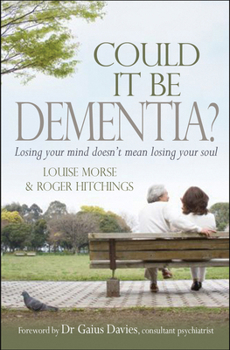
Could It Be Dementia?: Losing Your Mind Doesn't Mean Losing Your Soul

This book puts dementia into a Christian context, insisting that loss of memory or reason does not mean a person is worthless.Dementia is in the headlines on a daily basis. Much information is available but it is all factual with no spiritual content. Yet for Christians, dementia can raise questions unlike any other condition. Why does a godly old man begin to use language that has always been anathema to him? Why does a loving mother become stubborn, and suspicious? Where is God in all of this? This book offers information and reassurance gleaned from the extensive experience of Pilgrim Homes, a network of nine Christian care homes and a foundation going back to 1807.
Format:Paperback
Language:English
ISBN:1854248251
ISBN13:9781854248251
Release Date:March 2008
Publisher:Monarch Books
Length:224 Pages
Weight:0.50 lbs.
Dimensions:0.5" x 5.1" x 7.8"
Customer Reviews
1 rating
A journey into mens' souls in the midst of dementia
Published by Thriftbooks.com User , 16 years ago
Reviewed by Richard R. Blake for Reader Views (4/09) "Could It Be Dementia?" is the collaborative effort of Louise Morse and Roger Hitchings. The book begins by establishing what dementia is and what it is not. The authors talk about the care and resources available, how to prepare if you are diagnosed with dementia yourself, the role of providing care, and ways you can offer encouragement to others. The book is written within the context of eternity with a Christian perspective. Morse and Hitchings have thoroughly researched the material. The results are presented with clarity and follow a logical pattern of development. The authors discuss such helpful topics as conditions that can cause symptoms that look like dementia which include, among others: undetected cardiovascular disease, anemia, under-active thyroid, chronic alcoholism, depression, and other brain conditions. Comprehensive research leans toward a genetic predisposition as a primary cause for the disease. Another important aspect covered is in the area of preventative measures. Among others, these include: Take sensible steps in light of family history, make sure your blood pressure is at a good level, get regular exercise, have your eyesight and hearing checked regularly, socialize, stay connected, and talk to others often, get depression treated, build your brain capacity; change your routines, and draw close to God. I found the chapter "Diagnosing Dementia" extremely informative and helpful. The authors bring to light studies that have assembled warning signs to watch for. They discuss the diagnosis itself and various tests that are helpful in screening as they determine geriatric and cognitive concerns. A concern was expressed regarding the deep-rooted cultural attitudes prevalent toward aging and the physical impact of loneliness as a precursor to the disease. Important suggestions listed things churches can do in ministering to meet the needs of their congregants afflicted with dementia. The importance of "person centered" care, identity, and relationships were all emphasized. Another section alerted the reader of the dangers of "Caregiver Syndrome." Valuable tips are included for helping young children cope when a grandparent is weakened by dementia. The heartwarming stories and antidotes of individuals facing the results of dementia are presented in a humorous way that brings a smile to your face and tears to your eyes. These stories offer hope as we find delight in Christ, and anticipate with expectancy the promise of life hereafter, where body, soul, and mind, are pure, healthy and strong. "Could It Be Dementia?" is rich in encouragement and a wealth of well-organized information. It is a book that should be read and kept available for reference in the home of every family impacted by the dread disease of dementia. This is the most helpful book I have read on concerns for the aging and dementia as a disease. I highly recommend this book to caregivers, counselor
Copyright © 2025 Thriftbooks.com
Terms of Use | Privacy Policy | Do Not Sell/Share My Personal Information | Cookie Policy | Cookie Preferences | Accessibility Statement
ThriftBooks ® and the ThriftBooks ® logo are registered trademarks of Thrift Books Global, LLC
ThriftBooks ® and the ThriftBooks ® logo are registered trademarks of Thrift Books Global, LLC
