


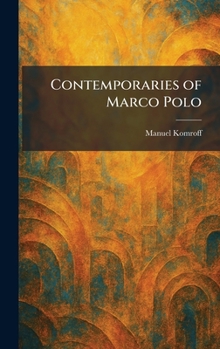
Contemporaries of Marco Polo

Select Format
Select Condition 
Book Overview
"Contemporaries of Marco Polo" is a compelling collection of medieval travel narratives that provides a broader context to the exploration of the East during the thirteenth and fourteenth centuries. This volume brings together the remarkable accounts of travelers such as William of Rubruck, John of Pian de Carpine, Friar Odoric, and Rabbi Benjamin of Tudela. While Marco Polo remains the most famous Westerner to traverse the Silk Road, these contemporary accounts offer vital, often more detailed perspectives on the vast Mongol Empire, the mysterious kingdoms of the Orient, and the cultural exchanges between East and West.
Readers will find vivid descriptions of the courts of the Great Khans, the customs of nomadic tribes, and the religious diversity of Central Asia and the Far East. These primary source documents are essential for understanding the medieval worldview and the early encounters that shaped global history. "Contemporaries of Marco Polo" serves as an invaluable resource for historians, students of medieval studies, and anyone enthralled by the age of discovery. It preserves the adventurous spirit and scholarly curiosity of men who ventured into the unknown to bridge the gap between disparate civilizations.
This work has been selected by scholars as being culturally important, and is part of the knowledge base of civilization as we know it. This work was reproduced from the original artifact, and remains as true to the original work as possible. Therefore, you may see the original copyright references, library stamps (as most of these works have been housed in our most important libraries around the world), and other notations in the work.
This work is in the public domain in the United States of America, and possibly other nations. Within the United States, you may freely copy and distribute this work, as no entity (individual or corporate) has a copyright on the body of the work.
As a reproduction of a historical artifact, this work may contain missing or blurred pages, poor pictures, errant marks, etc. Scholars believe, and we concur, that this work is important enough to be preserved, reproduced, and made generally available to the public. We appreciate your support of the preservation process, and thank you for being an important part of keeping this knowledge alive and relevant.
Customer Reviews
ThriftBooks ® and the ThriftBooks ® logo are registered trademarks of Thrift Books Global, LLC
