


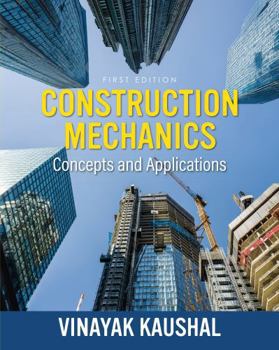
Construction Mechanics : Concepts and Applications

Construction Mechanics: Concepts and Applications introduces the key principles needed to understand forces, moments, and structural behavior in construction. Developed for both instructional and practical use, the book addresses the application of mechanics in real-world construction activities such as lifting, structural analysis, and detailing, providing a pathway from fundamental principles to analytical decision-making needed on job sites and design offices.
The book covers essential topics including quantities and units, Newton's laws, vector operations, equilibrium in two and three dimensions, structural analysis of trusses and frames, properties such as centroids and moments of inertia, stress-strain behavior, mechanical properties of materials, axial loading, thermal effects, and torsion. Each chapter contains construction-focused examples, solved problems, discussion questions, and key concepts, emphasizing practical engineering habits such as dimensional consistency, structured workflows, and the creation of free-body diagrams.
Construction Mechanics is designed for undergraduate students in construction, civil, architectural, or mechanical engineering programs. Its organized approach and practical orientation make it suitable for use in foundational mechanics courses.
Customer Reviews
ThriftBooks ® and the ThriftBooks ® logo are registered trademarks of Thrift Books Global, LLC
