


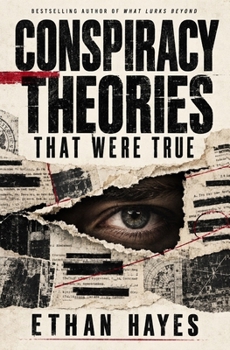
Conspiracy Theories That Were True

They called it paranoia. The documents called it policy.
For decades, Americans who said the CIA was drugging unwitting citizens, that government doctors were letting Black men go untreated for syphilis, or that the NSA was logging nearly every phone call in the country were dismissed as cranks. Every one of those claims turned out to be true.
This revised and expanded edition of Conspiracy Theories That Were True tells the stories of eighteen secrets that were denied, ridiculed, and then confirmed by declassified files, congressional investigations, court records, and the reporters who broke them open.
Inside you'll find:
MK-Ultra, the CIA's program of mind-control experiments on people who never agreed to take partTuskegee and Guatemala, where U.S. health officials watched patients suffer, or infected them on purposeOperation Northwoods, the Joint Chiefs' plan to stage attacks on Americans to justify invading CubaCOINTELPRO, the FBI's secret war on civil rights leaders and activistsOperation LAC, in which the Army sprayed chemical particles over American cities to study how they spreadThe Prohibition poisonings, when the government ordered industrial alcohol made more deadly, knowing people would drink itThe human radiation experiments, from plutonium injections to radioactive oatmeal fed to schoolboysBig Tobacco and Big Sugar, industries that bought doubt and bought scientistsThe Gulf of Tonkin and the incubator babies, two stories that helped take America to war and fell apart afterwardNSA mass surveillance, denied under oath three months before Edward Snowden proved itAlong with Operation Mockingbird, the CIA's heart attack gun, Operation Paperclip, Operation Snow White, and Operation Popeye's secret war on the weather.
Each chapter traces how the secret began, how it was hidden, who exposed it, and what changed afterward. This edition has been fact-checked and updated, and it now includes more than 1,000 footnotes and a full bibliography, so readers can check every claim for themselves.
This is not a book about believing everything. It is a book about evidence, and about the questions worth asking the next time someone tells you, "That would never happen."
Customer Reviews
ThriftBooks ® and the ThriftBooks ® logo are registered trademarks of Thrift Books Global, LLC
