


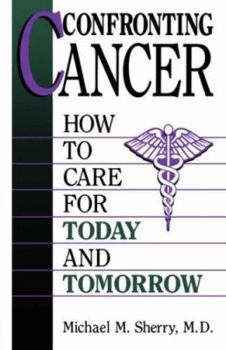
Confronting Cancer: How to Care for Today and Tomorrow

Select Format
Select Condition 
Book Overview
A practical and readily understandable resource book that interprets the complexities of cancer for the patient, family, and medical personnel
From the moment of diagnosis, the cancer patient embarks on a journey that can prove both daunting and overwhelming. Fears and choices abound, along with the need to understand the nature and ramifications of the specific illness. Having witnessed this devastating predicament among countless patients in his own extensive practice as a cancer specialist, Dr. Michael Sherry felt compelled to write a lucid and comprehensive cancer handbook for patients and their families coping with the daily reality of the disease.
Confronting Cancer: How to Care for Today and Tomorrow is a practical and readily understandable resource book that interprets the complexities of cancer for the layperson. In order to guide the patient and caregiver through the successive phases of the disease, including diagnosis, treatment, and day-to-day living, Dr. Sherry has carefully organized the book into three parts:
Part One emphasizes the distinctive nature of specific cancers (such as breast, lung, skin, and colon) and explains the basic rationale for treatment; Part Two discusses orthodox and unorthodox therapies; Part Three details common problems encountered by the patient (including getting a second opinion, frequent symptoms, and pain control).
The author also includes vital information on the nature and treatment of less familiar cancers affecting bladder and kidney function, the testicular area, and "unknown primary organ." While the vast majority of the over one million cancer patients in the United States receive technically sophisticated treatments, most patients are bewildered by the intricacies of the treatment process. Confronting Cancer clearly explains major cancer treatments, including chemotherapy, radiation, surgery, bone marrow transplantation, investigational therapy, "no therapy," and the dangers of cancer quackery.
From the moment of diagnosis, the cancer patient embarks on a journey that can prove both daunting and overwhelming. Fears and choices abound, along with the need to understand the nature and ramifications of the specific illness. Having witnessed this devastating predicament among countless patients in his own extensive practice as a cancer specialist, Dr. Michael Sherry felt compelled to write a lucid and comprehensive cancer handbook for patients and their families coping with the daily reality of the disease.
Confronting Cancer: How to Care for Today and Tomorrow is a practical and readily understandable resource book that interprets the complexities of cancer for the layperson. In order to guide the patient and caregiver through the successive phases of the disease, including diagnosis, treatment, and day-to-day living, Dr. Sherry has carefully organized the book into three parts:
Part One emphasizes the distinctive nature of specific cancers (such as breast, lung, skin, and colon) and explains the basic rationale for treatment; Part Two discusses orthodox and unorthodox therapies; Part Three details common problems encountered by the patient (including getting a second opinion, frequent symptoms, and pain control).
The author also includes vital information on the nature and treatment of less familiar cancers affecting bladder and kidney function, the testicular area, and "unknown primary organ." While the vast majority of the over one million cancer patients in the United States receive technically sophisticated treatments, most patients are bewildered by the intricacies of the treatment process. Confronting Cancer clearly explains major cancer treatments, including chemotherapy, radiation, surgery, bone marrow transplantation, investigational therapy, "no therapy," and the dangers of cancer quackery.
Format:Paperback
Language:English
ISBN:0306446448
ISBN13:9780306446443
Release Date:March 1994
Publisher:Grand Central Publishing
Length:375 Pages
Weight:1.07 lbs.
Dimensions:1.2" x 5.5" x 8.2"
Customer Reviews
1 rating
A superb, comprehensive guide for the lay reader
Published by Thriftbooks.com User , 25 years ago
The best review I can give of Confronting Cancer is that I'm a cancer patient, and this book gave me information I hadn't read even in books devoted just to my type of cancer. The first 150 pages consist of descriptions of the etiology and treatment of many different kinds of cancer. What's impressive here is that the book contains detailed information but can be understood by the lay reader. The rest of the book (about 200 pages) discusses such topics as treatment options and side effects, biological therapy, getting second opinions, alternative treatment, and getting one's affairs in order.What I appreciate about this book is that it gives a realistic picture and describes negative as well as positive effects of various treatments. I feel it gives the cancer patient a good idea of what to expect, and will be useful as patients move into different phases of their experience with cancer. So much information is conveyed here that a second or third reading would be worthwhile. This is one of the two or three most useful books about cancer I've found thus far.
Copyright © 2026 Thriftbooks.com Terms of Use
| Privacy Policy | Do Not
Sell/Share My Personal Information | Cookie Policy | Cookie Preferences | Accessibility Statement
ThriftBooks® and the ThriftBooks® logo are registered trademarks of Thrift Books Global, LLC
ThriftBooks® and the ThriftBooks® logo are registered trademarks of Thrift Books Global, LLC
