Book Overview
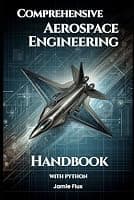
Unlock the full potential of aerospace engineering with the most comprehensive guide available. Dive deep into the intricate interplay of physics, engineering, and technology that defines this cutting-edge field. This exhaustive handbook is your key to mastering the mathematical and theoretical foundations necessary for designing state-of-the-art aircraft and spacecraft. With Python coding examples accompanying each chapter, this resource provides a practical framework that links theoretical concepts to hands-on applications. Suitable for students, professionals, and enthusiasts alike, this book is a definitive guide for anyone looking to excel in the realm of aerospace engineering. Key Features: - In-depth exploration of foundational and advanced principles in aerospace engineering. - Practical Python code for every chapter to bolster learning through application. - A vast array of topics covering critical components of aerospace design and analysis. - Insightful explanations on equations, principles, and mechanisms essential for aerospace success. - Guidance on implementing data analytics and simulations integral to modern aerospace challenges. What You Will Learn: - Gain a solid understanding of fluid dynamics through the Bernoulli, continuity, and Navier-Stokes equations. - Analyze various flow patterns with Reynolds number applications for identifying laminar and turbulent flows. - Calculate lift and drag for aircraft design optimization. - Explore thrust generation principles essential for overcoming aerodynamic drag. - Apply conservation laws to momentum, energy, and gases with practical aerospace implications. - Understand the mechanics of shock waves and isentropic flows through Mach numbers and specific heat ratios. - Delve into advanced aerodynamics with Prandtl''s lifting line theory and vortex dynamics. - Implement Euler''s Equations in solving inviscid flow problems effectively. - Master calculations for wing load distributions and aerodynamic lift using methods like vortex panel. - Perform structural analysis using finite element methods to assess stresses and displacements. - Evaluate aerodynamic performance through complex flow simulation using RANS equations. - Understand the significance of boundary layers and laminar-turbulent transitions in aerospace design. - Control aerospace environments with modal analysis and eigenvalue evaluations. - Optimize flight trajectories using advanced trajectory algorithms for efficiency. - Simulate projectile motion and analyze supersonic diffuser designs. - Use data fusion techniques to improve accuracy in aerospace navigation systems. - Evaluate solar sail dynamics for innovative spacecraft propulsion concepts. - Apply Monte Carlo simulations and risk analysis for aerospace project management. - Analyze long-term satellite operations with orbit decay and trajectory optimization. - Implement advanced coding solutions like neural networks for adaptive aerospace controls. - Design effective thermal management solutions through heat transfer analysis and component heat flux evaluations. - Develop radar cross-section predictions critical for stealth technology. - Optimize the aerodynamic shape of aircraft components for enhanced performance. - Understand acoustics impact on aerospace materials and optimize vibrational modes in spacecraft design. - Leverage ion thruster equations for high-efficiency space propulsion. - Utilize Bayesian networks for robust aero decision-making under uncertainty. - Enhance real-world aerospace applications with cryogenic systems design and analysis. - Enhance navigation systems using Kalman filtering techniques. - Manage aerospace resources with precise critical path method algorithms for complex projects. - Modernize control systems with neural networks for responsive autonomous vehicles.