


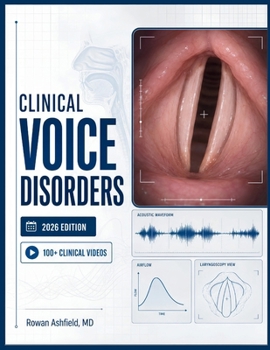
Clinical Voice Disorders: A Comprehensive Guide to Pathology, Evaluation, and Therapeutic Management

Clinical voice care demands more than naming hoarseness. You need to connect the sound you hear with laryngeal structure, respiratory drive, mucosal vibration, neurologic control, vocal load, patient goals, and the timing of referral.
Clinical Voice Disorders: A Comprehensive Guide to Pathology, Evaluation, and Therapeutic Management is built for speech-language pathology students, early-career clinicians, ENT teams, and voice-care providers who need a clear path from complaint to evaluation to treatment planning.
Clinical foundations of phonation, laryngeal anatomy, vocal fold vibration, resonance, and neural controlStepwise evaluation using history, auditory-perceptual assessment, acoustic and aerodynamic measures, patient-reported outcomes, and laryngeal visualizationPractical coverage of benign lesions, inflammatory disorders, neurologic voice disorders, muscle tension dysphonia, pediatric voice, professional voice, and performing voice careTherapeutic management chapters covering physiologic voice therapy, behavioral and manual interventions, medical and surgical collaboration, gender-affirming voice care, cough and upper-airway overlap, and cancer-related voice rehabilitationClinical images and illustrations throughout the text, plus more than 100 QR-code clinical teaching videos for procedure review, laryngeal visualization concepts, therapy demonstrations, and patient education supportReference tables for red flags, documentation, perceptual descriptors, lesion patterns, therapy selection, and vocal load planningUse this guide when you need voice-disorder reasoning that is organized, clinically usable, and grounded in the way real voice clinics work.
Add it to your clinical library and use it as a working reference for evaluation, therapy planning, and multidisciplinary voice care.
Customer Reviews
ThriftBooks ® and the ThriftBooks ® logo are registered trademarks of Thrift Books Global, LLC
