


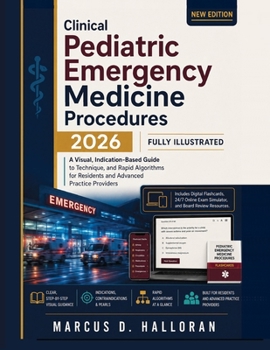
Clinical Pediatric Emergency Medicine Procedures 2026: A Visual, Indication-Based Guide to Technique, and Rapid Algorithms for Residents and Advanced
No Customer Reviews

The procedure is happening now. This book is organised for that moment. Pediatric emergency procedures are rarely difficult because the technique is
obscure. They are difficult because the child is small, the team is new to each
other, the equipment is unfamiliar, and there is no time to read three pages of
prose to find the one line that matters. Clinical Pediatric Emergency Medicine Procedures 2026 is built around that
constraint. Every one of its 28 chapters follows the same fixed structure, so
once you learn the layout of one chapter you know exactly where to look in all
of them: - Indications and contraindications - when to do it, and when not to
- Equipment - what to gather before you start
- Pre-procedure preparation - positioning, monitoring, consent, team roles
- Step-by-step technique - the procedure itself, in order
- Anatomic and technical pearls - what experienced operators watch for
- Complications - what goes wrong, and what to do about it
- Troubleshooting - a problem/cause/fix table for the moment it stalls
- Rapid Algorithm - a one-page flowchart of the whole procedure
- Sources to verify - the guidelines to check against local protocol Twenty-eight procedures, from the airway to the trauma bay Procedural sedation. Basic airway management and bag-mask ventilation. Rapid
sequence intubation. Difficult and failed airway algorithms. Needle and
surgical cricothyroidotomy. Supraglottic rescue devices. Peripheral and
ultrasound-guided vascular access. Intraosseous access. Central venous and
arterial access. Umbilical vessel catheterization. Needle decompression and
tube thoracostomy. Pericardiocentesis. Defibrillation, cardioversion and
transcutaneous pacing. Lumbar puncture. Bladder catheterization and suprapubic
aspiration. Laceration repair and foreign body removal. Splinting and closed
reduction. Joint aspiration. Burn assessment. Ocular and ENT emergencies.
Toxicologic decontamination. Neonatal resuscitation. Trauma and damage control. Twenty-five rapid algorithms Each procedural chapter ends with a single-page flowchart of the sequence, in
the same visual format throughout. They are designed to be found fast and read
under pressure - the step you are on, the step that comes next, and the point
at which you escalate. Written for the person holding the needle
This is a reference for residents, fellows, nurse practitioners, physician
assistants and emergency clinicians who perform pediatric procedures but do not
perform every one of them often. It assumes you know medicine and does not
waste your time explaining it. What it does instead is put indications,
technique, failure modes and escalation in a predictable place, chapter after
chapter.
Format:Paperback
Language:English
ISBN:B0HGBXNRJP
ISBN13:9798194619344
Release Date:August 2026
Publisher:Independently Published
Length:284 Pages
Weight:1.46 lbs.
Dimensions:0.6" x 8.5" x 11.0"
Customer Reviews
0 rating
Copyright © 2026 Thriftbooks.com
Terms of Use | Privacy Policy | Do Not Sell/Share My Personal Information | Cookie Notice | Cookie Preferences | Accessibility Statement
ThriftBooks ® and the ThriftBooks ® logo are registered trademarks of Thrift Books Global, LLC
ThriftBooks ® and the ThriftBooks ® logo are registered trademarks of Thrift Books Global, LLC
