


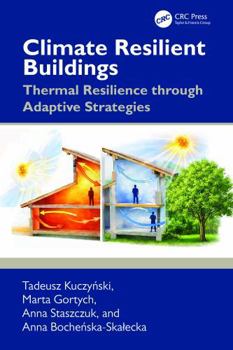
Climate Resilient Buildings: Thermal Resilience Through Adaptive Strategies

Climate Resilient Buildings: Thermal Resilience through Adaptive Strategies addresses one of the most pressing challenges in contemporary architecture: designing buildings that remain safe during extreme heat, cold, power outages, and energy system disruptions. This book argues that thermal resilience emerges from a hierarchy of architectural decisions, ordered by reversibility and operational dependence, which must be addressed from the earliest design stages before performance trajectories become fixed.
Drawing on full-scale experimental research at the University of Zielona G ra and approximately 30 case studies across diverse climatic contexts, this book demonstrates how passive strategies, renewable energy systems, and digital tools interact to sustain habitable conditions when mechanical systems are unavailable. It establishes a clear distinction between designing for resilience through multi-criteria optimisation and life cycle frameworks and verifying resilience through stress testing under extreme conditions.
Written for architects, engineers, planners, and students, this book promotes informed judgement and interdisciplinary collaboration as the foundations of climate-safe design.
Customer Reviews
ThriftBooks ® and the ThriftBooks ® logo are registered trademarks of Thrift Books Global, LLC
